Showing posts with label miniatures. Show all posts

Saturday, August 11, 2012

Mobile Frame Zero First Play

Jonathan and I got in a game of Mobile Frame Zero using the draft rules I got from backing its Kickstarter. I'm really impressed with the game despite our match-up not really capturing all its strengths.

Normally the first step to a game of MFZ is force creation. Each side, and there can be up to five sides, creates its force in isolation. The limits on a force vary based on whether you are going to play a skirmish or a battle, and how many people are participating. We were playing a two player skirmish, so each side could have 4 to 6 mobile frames and 3 stations (objectives).  

Each frame can have from 0 to 4 attached systems, with each system being either defensive, movement, surveillance, or attack.

Since we were using the two forces I'd put together a while back, we skipped this step and moved on to calculating the asset value of the forces I'd constructed. This led to our first problem.  I'd created two forces that while not identical, were the same size in terms of number of mobile frames and total number of attached systems. This was a problem because we didn't get to see how the system handles asymmetrical situations, which is supposed to be one of its strengths.

There is a rule for dealing with this situation that forces asymmetry, but despite looking for it multiple times, I somehow kept skipping over it. The way we ended up resolving it worked, but I think it probably gave Jonathan a significant handicap in play.  We simply rolled off to see who started with the initiative. The fact that I kept it the entire game after winning the roll supports the idea that doing it that way gave me an advantage.

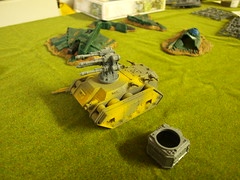
Carnage in the middle of the table near the end of the game.

Once we started playing we did most things right, and the actual play was a lot of fun. The action order was a little tricky to grasp at first due to an interrupt mechanic that can trigger the actions of a string of mobile frames that haven't gone yet whenever one is targeted that hasn't yet had an action that turn. Once that had happened a couple of times though, it was quite simple to deal with.

There were only two situations that I can find that we handled wrong in play. First, we were overly generous to the attacker when determining cover.  The rule of thumb in the game is to be overly generous to the attacker when determining line of sight, but to be generous to the defender when determining cover. So let the attacker take the shot if he can see any of the defender, but give the defender cover if any part of it is behind suitable cover.  

The other situation was one that I had to go onto the forums at the Mobile Frame Hanger to find the answer to. Whenever a mobile frame takes damage during the middle of its action (which happens a lot due to the interrupt mechanic I mentioned above), that damage doesn't take affect until after it is done taking its action.  We got that right. What we got wrong was that there's an exception in the case were a mobile frame is completely destroyed in the middle of its action. In that situation the mobile frame is destroyed immediately and does not get to complete its action.

I'm really looking forward to playing this more now, and to getting the final version of the rules. My only reservation is that due to the nature of LEGO, I probably won't be taking this off my property to play. Too easy to lose the pieces. For now I'll just have to host any games I play in.

Thursday, July 21, 2011

My Take on the Origins Awards

If you won an award at Origins 2011, then you should probably just move along, because I'm likely going to offend you and that's not my intention. This is meant as a criticism of the awards themselves and not those that won them.

I don't think there was a bad product among the winners, I just think that many either weren't the best, or weren't properly classified.

It's been about three weeks now, and I've had some time to digest the results of the 2011 Origins Awards. Listening to episode 215 of the Dice Tower helped both confirm and solidify my initial impressions: the Origins Awards are a joke.

I don't want to minimize the accomplishments of some of the winners, particularly the folks at Evil Hat for their wins with the Dresden Files RPG, but in most cases the best of those nominated did not win, and in several cases it was the worst that did.

Let's look at the winners, starting with the single most egregious in my mind: Best Historical Board Game. The winner of that category was Catan Histories: Settlers of America Trails to Rails. This game shouldn't have even been nominated to this category. Just because a game has a lightly pasted on historical theme does not make it a historical game.

Moving on, we see Zombie Dice winning the best Family, Children's, or Party game. First, the category itself has issues. A family game is different from a children's game which is different from a party game. Mashing them all together makes little sense. I suppose they are going for best "casual" game, but they need to rethink the definitions of the board game categories if that's what they are going for.

Zombie Dice is not a terrible game, but every other nominee in the category is better. If you tell someone "you can only have X number of games for the rest of your life" no one is going to choose Zombie Dice. At least a couple of its competitors in the category could conceivably end up on such a list.

The same could be said of the winner of the Best Traditional Card Game category. Back to the Future is not a game I've played, but it's pretty obvious that the only reason it won was due to the theme. I've not actually played any of the games in the category, but I've heard really good things about some of them. I've heard no one praising Back to the Future in a similar manner.

For Best Board Game, the apparent top tier of the board game categories, at least the winner is a good game. Unfortunately it's also the weakest of the nominees. Every game in the category is better, but Castle Ravenloft apparently wins because it's Dungeons & Dragons.

Moving on now to roleplaying. While I think Dresden Files is a great game, and a serious contender for best roleplaying game, I would have chosen Fiasco. Everyone I know who has tried it has made it one of their go-to games. It's simple and innovative, and consistently produces good gaming sessions.

Best Roleplaying supplement is a close one. Having run both Dresden Files and Pathfinder games I have found the Advanced Players Guide more generally useful than Our World, but am willing to admit this is probably the most subjective call out of a lot of subjective calls in this article. As such, this is the one category where I don't really have an issue with the winner.

Moving on once more, we come to Best Hobby Game Accessory. Our nominees include such wonderful choices as Color Primer: Dragon Red... really? People couldn't find better nominees for this category than a color of paint? At least it didn't win, but the winner was almost as bad: a Cthulhu dice bag. A dice bag won the Best Hobby Game Accessory. I guess the Crown Royal bag wasn't eligible. Unless the bag actually opens into an extradimensional space, I think a better candidate could have been found. In fact, I have one, actually an entire category: everything else nominated was a better choice, except maybe the paint.

Most of the problem here is the over-broadness of the category. Everything else was specific to miniatures painters or players of a specific game, whereas the dice bag is more generic. Never mind that it doesn't even look very practical: it's cute and has broader appeal, so it wins.

I would have given Best Gaming Publication to Hamlet's Hit Points, but I haven't read Shadowrun: Spells and Chrome, so I can't say it didn't deserve to win. I can say that a category that includes both gaming fiction and non-fiction is a poorly designed category.

Best Miniature Rules: Heroclix won this. I know a lot of people like Heroclix, but were the rules included in the Blackest Night Starter Kit significantly different enough from previous editions to warrant inclusion in this category? Also, a BattleTech technical readout counts as rules? This category needs to be tightened up.

I can't really comment on the Best Play by Mail or Play by Email game, except to point out that the very existence of this category really calls into question the thinking process of those behind these awards. It's 2011, you have ten categories to cover products in a vastly diverse hobby, and you dedicate one of them to Play by Mail games.

I do have to give them credit for the Hall of Fame entries, which was the one area of the awards that I could agree with 100%. Although, paired with the Play by Mail category, I think this just goes to show that the Origins Awards has a much better grasp of the past of gaming than it has of the present.

Of course, anyone can whine about the poor quality of gaming awards, but what would make for a more useful system? I have some ideas, but I'll save them for a later post.

Monday, July 18, 2011

My Changing Preferences in Gaming

I'm going to muse a bit about how my hobby time has changed over the past few years. I'm not sure how interesting this is going to be to anyone else, but it was interesting to me, so here it is.

A while ago I discussed why I'm not playing many miniatures games anymore, and mentioned that my current "preference hierarchy" when it comes to games has changed. It used to be that miniatures games were near the top of my hierarchy, but they're now below board games and RPGs. I thought I'd go over some of the reasons why that's the case.

One reason is prep time. Miniatures games suck up time outside of actually playing the game. Assembling and painting models take me forever. RPGs also take a certain amount of prep time, especially when running them, which is one reason they're behind board games which take minimal prep time, but it's minimal when compared to miniatures games, at least for me.

Prep time wasn't really a factor when I was single. In fact, it was a bit of a bonus as if I didn't have anything to do I could work on miniatures. At this point in my life there's rarely a time where I "don't have anything to do," even though I technically have more "free time" right now then at many points earlier in my life.

Another reason is community. There's a couple factors involved here, and I want to start off by saying I don't mean to offend anyone in the local gaming community. They're mostly a great bunch of people, and I know at least a couple of them read the blog. The thing is that they're not the community I'm used to.

I first got talked into playing Warhammer Fantasy and 40K by a couple of my best friends from college. We had played RPGs and Battletech back then, and when years later I moved out to California they roped me into playing Fantasy and later I roped them into playing 40K. Our games were infrequent, but when we had them I was always playing with at least one guy I'd known for years. The games had their share of trash talk, but overall it was an extremely casual environment.

After the Warhammer group ceased being able to get together, I got into Flames of War mainly just to try painting the models. It was only later that I got the chance to play it. The guys I played it with weren't guys I'd known for years, but they were still very casual in their play.

When I say casual, I mean that we had no interest in tournaments. We played to win, but we didn't spend hours trying to put together the ultimate list. We played with armies we thought would be fun to play with. Although they were largely strangers when we first started playing, I count some of those guys among my best friends now.

The community here is different. Even though some complain about the lack of turnout at tournaments, it's actually incredibly tournament focused. The vast majority of the players around here play in tournaments. A higher percentage than I've seen anywhere else I've played (which admittedly hasn't been that many places).

I've never been interested in tournaments, and even if I was I couldn't do them because of my schedule. That leaves me with a community that I don't really fit into all that well.

Without an active community, there's a lot less incentive to keep up the level of work it takes to stay involved with a miniatures game.

The final reason is money. This isn't a huge reason for me. I still spend a lot of money on hobbies, just not on miniatures. Still, it is a factor. When I was single, if I wanted to spend a little extra on miniatures I could choose to not go out to eat for a while. For some reason my wife doesn't seem pleased when I tell her we're not going out to eat tonight because I bought some miniatures earlier in the week...

So, that's why miniatures have fallen back behind RPGs and board games. They have less prep time, I have a small but active community that plays them, and they cost less money (for the most part).

Thursday, July 14, 2011

BattleTech

BattleTech was the first miniatures game I ever played, although I didn't realize it at the time. BattleTech is one of those rare hybrids between miniatures and board games (and at times even RPGs), and I always thought of it as more of a board game, even when I was using miniatures to play it.

The thing about BattleTech is that while it's a decent game, it was never the game itself that really attracted me to it, it was the background. The background of the Succession Wars that pitfive houses in a free for all fight to claim control over humanity had a level of realism and detail that the actual game seemed to sometimes lack, at least for a young history and politics nut.

I was hooked on the universe from the time I first bought the game (I think probably around 1986) right up until the appearance of the Clans in 1990. The appearance of the Clans (which I was not a fan of at the time), combined with my eventual graduation from college, led me to abandon BattleTech for a period of over 15 years, but then Catalyst Games took over.

I was impressed by the production value they put into the new starter box in 2006, although not enough to actually buy it at the time. I was equally impressed by the introduction of the Sword and Dragon Starterbook that went back to the roots of the game by bringing McKinnon's Raiders and Sorenson's Sabres back into the lore of BattleTech. These were units covered in two of the original three sourcebooks for the game, and personal favorites of mine.

This is all a long-winded lead-in to how I've been totally diving into the current line of products being put out by Catalyst Games. Their take on the rules has been impressive. The core system is the same as it was back in the eighties, but with more polish. The first book, Total Warfare, was originally published by Fanpro and contains the core rules for 'mechs, aerospace, vehicles, and the various forms of infantry available in the BattleTech universe. This book is designed as a reference manual, not a tutorial. It says right on the back cover to get the starter box if you're new to the game. This let them put out a solid reference manual that contains just the core, 'tournament legal', rules.

The second volume in the series of rulebooks is the TechManual. This book is slightly larger than Total Warfare, and is all about constructing the units that have rules in Total Warfare. This book is a gearheads dream. Battletech has always had solid unit construction rules, and this tradition continues with the TechManual. Together with Total Warfare this book makes up the core rules of the system. Everything else is advanced/optional rules.

There are three volumes in the advanced rules series, two of which have been released. The first is Tactical Operations, which covers advanced optional rules for ground combat. There are a lot of good ideas here presented in a modular format so that you can just add in what you want to, without having to take the whole batch.

The second is Strategic Operations, which does for aerospace combat what Tactical Operations did for ground combat. It also does a few other things. It introduces repair and salvage rules for use in multi-battle campaigns. It also provides the BattleForce rules for fighting larger conflicts where each unit is roughly four to five times the size of a unit in standard BattleTech. Finally, it provides rules for playing BattleTech without the hex grid, turning it into a more typical miniatures game.

The third volume, yet to be released, is Interstellar Operations. This is proposed to include rules for all the other scales above Strategic Operations, up to complete interstellar wars.

There's one more hardcover volume: A Time of War. This is the BattleTech RPG. As an RPG its mechanics are rather dated, but it does expand the coverage of scale in the BattleTech universe down to man-to-man combat. It also provides additional options for players who want to play a BattleTech campaign that tracks the development of their MechWarriors.

I was pleased to see that some of the advanced abilities available to MechWarrior characters allow them to duplicate feats performed in the BattleTech fiction that otherwise aren't modeled in the rules. This was always a big issue for me back when we were playing in college.

Finally, since I first rediscovered the line, Catalyst has put out a new version of the starter box that is an improvement over the old one. It includes enough cheap plastic miniatures to get you playing out of the box, as well as a couple of better quality plastic kits. It also includes the core rules you need to play along with a couple of mounted maps to play on.

While I will probably never get back into this game in the way I once was, it's nice to see that it now exists in a form that more or less like what I always wanted. Now I just need to invent a time machine and send it back to my college self.

Monday, May 30, 2011

Black Powder

This is one of those posts I started a while ago, last June to be precise. I read the rules to Black Powder around the same time that the rules for Warhammer Fantasy 8th Edition came out, which is why I make a few comparisons between the two. I like Black Powder a lot, although it's unlikely I'll ever get to play. I'll get into why that's the case later on.

Black Powder is a game covering the black powder era of warfare during the 18th and 19th Centuries. This covers many famous conflicts including the American Revolutionary War, the Napoleonic Wars, the American Civil War, the Crimean War, the Zulu War, and many others.

The game is written by Rick Priestly and Jervis Johnson, best known for their association with Games Workshop. With this in mind I expected to encounter a typical GW style game, and instead found myself pleasantly surprised to find something quite different. To start with, there's no "buckets o' dice" mechanic here. Most combats look like they won't involve any more than half a dozen dice per side to resolve.

There's also none of the typical "tabletop carnage" involved in GW games, where players find themselves removing models from the table nearly as fast as they put them on there in the first place. Casualties are kept track of by placing tokens next to a unit, not removing models from it. Models don't come off the table until a unit is completely routed, at which point the entire unit is removed. I like this because after taking the time to assemble and paint an army, you want those models to actually stay on the table for a while.

Unfortunately, there are several factors that will keep me from ever playing this game. The biggest one is simply that I don't know anyone else around here who would be enthusiastic enough about playing to keep me enthusiastic enough to build an army. I'm past the point of being able to be the driving force behind generating interest in a new miniatures game. I just don't have the free time to evangelize for a new game.

Second, I don't have an army for the period. I'd love to put together a Civil War force using some of the Perry Miniatures plastics, but without someone to play against I don't really need to start another miniatures project that I would never finish.

Third, I don't have a big enough table. The game calls for tables ranging from 9' x 5' to 12' x 6', which are quite a bit larger than the standard 6' x 4' tables that are available around here. I have the room to put a bigger table in the garage, but would have to assemble it first.

So, why do I want to play this game instead of a more popular "big army" game like Warhammer Fantasy? There's a few reasons. First is the "herohammer" factor. In Fantasy it often all comes down to the character models, and this doesn't appear to be any less true in 8th edition. If I'm playing an army game, I want the army to matter. If I want individuals to be the deciding factor then I'll play a skirmish game.

Second, there's command and control. The one place that individuals should matter, is the one that Fantasy doesn't even model: command and control. With a few special exceptions based on the army you're playing, units in Fantasy do exactly what you want them to. That rarely happened in history, and I've found it's generally more entertaining to play a game where things don't always go according to plan.

I do realize that Warhammer Fantasy has a basic morale system, but as it exists in that game, I don't really count that as command and control. Units still do exactly what you want them to up to the point that they run away after taking too much damage and failing a morale check.

Third, the army construction. I want to play a game where you win on the tabletop, not in a database. I'm really starting to dislike army construction as a part of the game. I'm starting to prefer scenario based games where the forces are either based on history, or simply designated by the scenario designer.

These issues are absent in Black Powder. There are no "heroes" modeled in Black Powder. There is a command and control system that can lead to units not following your orders, and instead doing something else entirely. There are some very basic point values in an appendix for judging balance, but Black Powder is not an army construction game. It's a game intended to be played using individual scenarios either designed by a neutral umpire, or mutually created by the opposing players.

Overall, it's designed to be fun. Invite some friends over, have a few beers, and play out a scenario not to win at all costs, but just to see what happens.

Not that I don't like a competitive game, but it seems like all there is to the Warhammer games most of the time is the competition. Black Powder seems to bring more than that to the table.

While it's unlikely that I'll ever play Black Powder, the designers recently released Hail Caesar, an adaptation of the Black Powder rules to the ancients period. Given that I already have a partly assembled Roman army, it's much more likely that I'll eventually be able to get a game in using Hail Caesar, although it's still a longshot.

I don't have a copy of Hail Caesar yet, but after I get a chance to read it I'll try to post my thoughts on it, and I'll try to do it less than a year after I read it.

Monday, May 23, 2011

Force on Force

This is an interesting set of skirmish level rules for modern warfare. I'm not sure how accurate my information is on the history of this game, but from what I've seen it appears to have its origins as Ambush Alley. Ambush Alley is apparently a game designed to model the kind of modern asymmetrical conflicts typified by recent US conflicts in Iraq and Afghanistan, where conventional forces find themselves fighting against irregular insurgents. Force on Force takes those rules and expands them to allow for more conventional conflicts between two regular forces, or conflicts with a mix of regular and irregular forces on either or both sides. The new Force on Force book from Osprey appears to be the second edition of this game, with the first published by Ambush Alley games.

The new book is the same kind of high quality production that Osprey became known for with Field of Glory, at least in terms of materials. Sturdy hardcover binding, full color printing, and lavish illustrations. Although I haven't playtested them, the rules seem just as solid as the physical book. Keep in mind that the game is purely scenario driven, and not point based. The rules are meant to reflect the realities of combat in a playable manner, not provide balanced matchups for tournament play. They appear to have accomplished that goal.

Unfortunately, the book is marred by poor editing. Numerous minor typos can be found scattered throughout the book. There's also a handful of more serious errors that will require errata. Most notably two missing charts which have already been posted on Ambush Alley's site in an errata document. Fortunately, both charts are related to special rules unlikely to come up in the average game.

There are three editors listed, but two of them appear to be one of the author and his wife. I hope that in the future Osprey will consider bringing in a professional game editor to do at least one pass though their core rules, if not every supplement they publish. Such an editor would have caught most of the problems with this book before it went to press.

Still, I'm happy with my purchase. A solid set of rules with all the data you need to play scenarios set in the "modern" era, basically from the first Gulf War forward. Supplements should push this back to WWII. There's already a Vietnam supplement planned for later in the year.

It uses a unique initiative system where one side controls the initiative throughout a turn, while the other side can only react to the actions of the first player. Whether or not the non-initiative side can gain the initiative in the next turn depends on the scenario being played, and the results of the current turn. This appears to result in a game that is much more interactive than the typical igo/ugo, or even that found in alternating unit activations.

The overall design is focused on affects rather than causes. Much of the hardware is abstracted. There are no lists of small arms. What counts is the skill and morale of the soldiers fighting, not their gear. If there is a true disparity in gear (such as a unit with bolt action rifles facing one with assault rifles) that will be reflected in die modifiers, either to the number of dice rolled, or the type of dice rolled.

Speaking of dice, the game does not limit itself to the d6. It uses d6s, d8s, d10s and d12s; and recommends you have at least ten of each. The "nearly universal" mechanic for using these dice is 4+ for success, with the type and number of dice being used the main differentiator in quality, rather than a host of + or - modifiers (although they occasionally creep in).

The core rules are for infantry, but the game also covers vehicles, airmobile operations, air support, artillery, and a host of special situations. These latter include such things as cavalry, IEDs, civilians on the battlefield, and much more.

Admittedly, I'm not sure I'm fully comfortable playing games set in most of this time period. A lot of people have issues with wargames that cover recent conflicts, and my own comfort zone begins roughly a decade in the past. For example, I'm more or less OK with playing out scenarios set in the first Gulf War, but scenarios set during the invasion of Iraq in 2003 (covered by the first scenario book for the game) are still a little iffy for me, while the current conflict in Afghanistan is pretty much right out (covered by the second scenario book out for the game).

As a result, I probably won't get a chance to give this rules set any actual play until they start covering some of the less recent conflicts.

Friday, April 08, 2011

Awesome Miniatures Gaming Room

Aside from a little bit of Dystopian Wars, I'm pretty much out of miniatures gaming at the moment, but I just had to share a link to this guy's gaming setup.

Monday, October 04, 2010

Too Much of a Good Thing

I've taken a glance at the new 8th Edition Warhammer Fantasy Battles rules and they look good. I'm especially pleased that guess ranges are gone. Guess ranges are the dumbest idea ever introduced to miniatures gaming and I'm glad to see them finally gone from Warhammer Fantasy Battles. All hail pre-measuring!

I could do a whole essay on why pre-measuring is a good thing, but there's no real need now since guess measurements are finally on the way out. That's not what this post is about. This post is about why despite really liking the directions being taken by Games Workshop in 8th Edition, I'll probably never play it.

I had high hopes. I totally planned on putting together 500 points and taking it to the release event at the FLGS. Then, the night before the event, I had the realization: it was scheduled for the afternoon. See, I can't do afternoons anymore, not even on weekends. This is the primary thing keeping me from having played more than a couple miniatures games since moving back to Arkansas. The people playing around here more often than not get together in the afternoons for pickup games, whether on weekends or on weekdays, and the events are always held in the afternoons.

This is understandable. Most people are available on weekend afternoons. It's just my bad luck that I'm not usually one of them. It's my worse luck that I keep forgetting that I'm not usually one of them.

I've semi-committed myself to at least two or three miniatures events only to back out at the last minute when I realize that I can't actually be there at the required time because I'd have to leave half way through it.

If this is starting to sound like a whinge about my inability to play miniatures games, it's not meant to be. Well, not really. I know that if I really wanted to play miniatures games that I could find a way to do so, but I've also come to realize that while I'm an omnivorous gamer, I do have a definite preference hierarchy amongst my hobby games. At the top of that hierarchy are board games. Next on the list are RPGs, and only after that are miniatures games.

My preference hierarchy hasn't always been ordered like this. Playing miniatures was at the top of my list for the larger part of the past decade, but that simply isn't the case anymore.

If I have to give up the miniatures in order to keep playing the board games and RPGs then so be it. I still hope to eventually get some miniatures games back into my schedule, but I'm not going to worry about it too much if it doesn't happen. I'll still follow the trends online, and read the rules, because that's what I do, but for now I more or less accept that is probably all that I'll be doing.

If I do get to play more miniatures games it will most likely be with skirmish games like Lord of the Rings Strategy Battle Game or Malifaux, not with the big army games like Warhammer Fantasy Battles. Like all day roleplaying sessions, or a solid weekend playing a MMOG, those big games are just too much of a good thing.

Tuesday, September 21, 2010

Here We Go Again...

Despite not having any chance to play miniatures games in the past several months, and despite saying on multiple occasions that the miniatures didn't appeal to me, I've given in to the siren call of Malifaux.

There were a couple of factors involved in my downfall. The local miniatures crowd has been developing some interest in the game, which I've been observing on the local miniatures forum: Hogs of War. One post in particular proved a tipping point in that it mentioned a crew of Asian ghosts. I didn't recall any Asian ghosts from my previous looks at the game, so I went and checked the site and found that they'd released a lot of new models with the second book, and that there was indeed a crew of Asian ghosts.

I was still able to resist until the FLGS, Castle House Games, got in a rule book and some starter boxes. My friend Gary at Black Diamond Games, my old FLGS, had tried to get me to order the book from him a couple of times, but without it being physically in front of me I'd been able to resist. Once I could actually pick up the book and flip through it that resistance crumbled. I bought the book and a deck of cards and went home to read it.

I'm not really sure why I bought the deck of cards, I was 90% committed at this point, but still wanted to read the book to see for myself whether it was a game I thought I might enjoy, and whether there were any factions I thought I would find interesting to play.

It only took me a couple of hours to read the rules, skipping the fluff and miniature stats. I was impressed, and I knew by the time I finished that I wanted to give the game a try. I then read the fluff and was impressed even more. I still want to try the Asian ghosts, but they're in the second book, and I wanted to start with a crew from the first one. I decided I wanted to get the Rasputina boxed set.

Rasputina is basically an ice mage with a bunch of ice constructs as allies. None of the miniatures in the set are grotesque, and she's part of the Arcanist faction, which is probably the least evil faction in the game, in my view (none of the four main factions can really be considered "good guys").

The problem was that the FLGS didn't have one of those sets in stock, and I didn't want to wait on a special order, so I ended up getting a couple of other sets instead: The Victorias and the Redchapel Gang.

My focus with this new game is to actually play if I get the chance. As such, I have no intention of painting the models. I may do so eventually, but for now I'm satisfied just having them assembled. If I can actually get some games in, then I might bet more serious about getting some painted.

Monday, January 25, 2010

Uncharted Seas - First Game

Dragon Lords vs. Shroud Mages 1/25/10
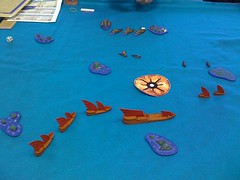
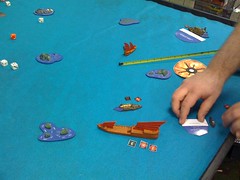
We had our first game of Uncharted Seas tonight, and it was fun, but I think I have an issue with the basic scenario.

It was my Dragon Lords vs. Jonathan's Shadow Mages in a "turn up and fight" scenario which is an equal point value matchup where the last man standing wins.

I scored first blood by getting a lucky critical early on against one of his cruisers, but it was downhill from there for my poor elven overlords.

We did have some cool incidents with the highlight being a great little fight where he crashed two of his frigates into one of my cruisers. One frigate sunk, but the other survived, and in the ensuing boarding action managed to achieve mutual annihilation, leaving both ships as derelicts for the remainder of the game.

Another cool incident came a bit after that when my last remaining frigate swooped into range of his battleship and set off a spell that left two fires raging on it. Unfortunately, the fires ended up doing little damage, but it was still cool.

It was at this point that I was pretty much out of the game. After the last frigate was duly dispatched for its impertinence in challenging the enemy battleship, I was left with two ships, both damaged, one of which only survived another turn before joining its companions at the bottom of the sea.

This was where things got boring for me. Knowing I was going to lose was not an issue, what was the problem was that I had nothing left to do. My opponent still had three squadrons left, and a total of five models. I had one squadron of one model, and it had already taken enough damage that I couldn't afford to split my fire. My turn took about two minutes to my opponent's ten at that point, and the game went on for several more turns before my last ship finally went under.

As it turned out, I was able to do some damage, and by the end of the game my opponent only had three ships left, one of each class, but that makes it sound closer than it was because his battleship was still nearly undamaged.

This lack of things for me to do for the latter third of the game is a problem with the scenario. The last man standing victory condition looks like it's going to result in this ending most of the time. Fortunately, there are other options. In addition to a couple of ideas in the rulebook, Craig Gallant over at the D6 Generation has come up with a few ideas on his site. I'll probably steal one of them for our next game.

There will be a next game. I like the system, I think it just needs better scenarios. It possibly also needs better terrain. I'd like to get some bigger islands made up for this, along with some other types of terrain.

It's also possible that a simple turn limit might do the trick, although I'm afraid that a fast fleet might be able to get in an early kill and then just play keep-away for the rest of the game. We might have to try it though, and see how it works.

Dragon Lords vs. Shroud Mages 1/25/10

Sunday, January 24, 2010

Dragon Lords

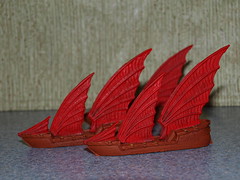
Dragon Lords Cruisers
As you can reasonably infer from my lack of posts about it lately, I haven't been doing much painting. Fortunately, I have a game of Uncharted Seas scheduled for Monday, and my opponent has already fully painted the fleet that he just received less than a week ago. That's spurred by lazy procrastinating ass to get busy on at least one of the three fleets I have had for over a year. Since my opponent has a Shroud Mages fleet, I decided to save my Iron Dwarf fleet for later, mainly so that any observers don't think that the game is only about ironclads. That left either my Dragon Lords or my Orc Raiders. Since the Orcs aren't assembled yet, it was an easy choice to go with the Dragon Lords.

I've always known that I wanted to do the Dragon Lords in bright colors, preferably reds given that I rarely work in that part of the color wheel. I also wanted to keep things simple since I only had a couple of days to finish the project if I wanted them ready for the game. Beyond that I really didn't have a plan going into the project. The end result is a bit of a fortuitous accident, but I'm quite pleased with it.

I started with the primer, a standard ruddy brown that I acquired specifically for this project some time ago. I originally thought that I might just primer the model, add a few details, and then give it a wash, but I decided to put a bit more work into it, and am glad I did. I ended up doing a natural wood color for the hulls almost by accident, using a brown that I thought might be a bit more reddish than it turned out to be. I then used a standard red for the sails, and washed it all with a dark brown wash after adding a few details.

The entire project only took three days. Primer was applied Friday morning. Friday evening I did up one frigate to see how it looked, and did a little work on a couple more. The bulk of the painting was done Saturday afternoon and evening, with everything done but the sealing by the time I went to bed. The only thing done on Sunday was to apply the sealer.

The paints I used are as follows:

Primer: Krylon Ruddy Brown
Hull: Vallejo Game Color 42 Parasite Brown
Sails: Vallejo Model Color 947 Red
Ballistae: Citadel Foundation Iyanden Darksun
Cannons: Vallejo Game Color 1 Chaos Black (I think that's what it's called, the bottle I'm using actually has a blank label)
Cabin Windows: Vallejo Model Color 915 Deep Yellow over Citadel Foundation Iyanden Darksun
Wash: Citadel Wash Gryphonne Sepia

Dragon Lords Starter Fleet

Thursday, December 03, 2009

They're Here!


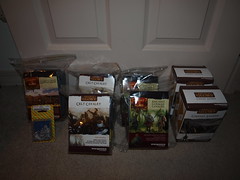
The rest of the miniatures for my army came today (well, yesterday, but yesterday only ended a few minutes ago as I post this), so I thought I'd post a "before" picture of the whole army. Of course, the boxes are empty now as I've been working on the legionnaires for a while. Everything is from Wargames Factory except the blister which contains some metal tribunes from Foundry Miniatures. I'm going to use those on my command stands.

The change in packaging is interesting. You can now see the sprues through the clear plastic, which is designed to hang from a retail display hook. The bags open at the bottom with a simple resealable fold (resealable glue, not a ziplock). The cardboard insert has very basic assembly instructions on the back, but no diagrams. Better than the original release, but not by a lot. Overall, I think I still prefer the original cardboard box, but the bag is probably more practical both for manufacturing and retail display.

I'm looking forward to assembling these guys, but I'll probably try to finish my legionnaires first, so this may be the last time you see them for a while.

Saturday, November 28, 2009

Roman Update


I have still been working on my Romans, slowly. This has been despite being distracted by other stuff, mainly computer games, including Dragon Age: Origins, which was quite good.

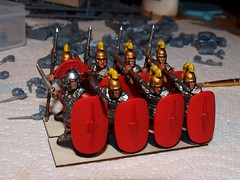
Since I finished up Dragon Age, I've been on a bit of a roll with my miniatures, and now have about a third of the legionnaires finished, aside from completing the basing. I've even gone so far as to order the rest of the miniatures I need to complete the army, as I've become fairly confident in my ability to finish up this project.

At the top of this post you can see all the miniatures that I've completed to date. There's another four on my painting table, and another battle group of 16 is in the final stages of assembly. Assembly is a bit tricky with these guys due to the ranking up issues I've discussed in the past, so instead of trying to assemble them all at once, I've been doing them in stages to help me focus on getting them where they can rank up properly. So far it seems to be working fairly well.

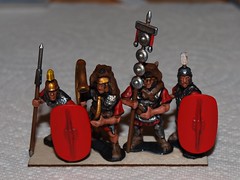
Below you can see my first 'command' stand that includes a cornicen (musician), signifer (standard bearer) and optio (NCO responsible for keeping the other legionnaires from retreating without orders). The stand has no game effect in Field of Glory, it's just for looks. When placed in the back of a battle group, and a stand with a centurion is placed in the front, it completes the mini-cohort look.


Monday, November 02, 2009

The Cohort


Above is one of three pictures I took of my first two Roman bases. You can see the other two if you click through to Flickr.

My goal here is to achieve a quality similar to that of pre-painted miniatures, and I think I've achieved it. There are a lot of things I could do to improve the miniatures. Doing the leather details on the armor, some hi-lighting on the faces, applying transfers to the shields, and detailing the open parts of the sandals would add a lot to the appearance of the models, but at the expense of a lot of extra time. With 80+ Romans alone to paint for this army, plus 60+ other models (many of which are cavalry), I really need to keep things simple if I ever hope to finish.

These are based using .8mm plywood bases from Litko Aerosystems. So far so good, although I'll withhold my final judgment until after I apply the basing materials. Getting them ranked up is the most difficult part of the entire project. The depth of the bases is the problem. You have to model the miniatures with their bodies at just the right angle to get them to rank up properly without hanging over the front or rear of the base.

Next up is to finish modeling and painting the remaining two stands in this first battlegroup. I've got six of the eight models primed and on my painting table now, including the signifer and the cornicen (standard bearer and musician). I just need to finish modeling the optio (second in command of a cohort) and one more legionnaire to round out the century.

I've sat down and figured out what this army is going to consist of if I finish it:
20 stands of Legionnaires
6 stands of slingers
6 stands of archers
8 stands of heavy cavalry
8 stands of light cavalry
3 command stands (probably 2 infantry and 1 cavalry)

That's a total of 645 points and around 155 models, give or take one or two depending on how I do the command stands. To do it I need a box of Numidians, 2 boxes of Celt Cavalry, and 2 boxes of German Cavalry, all from Wargames Factory; plus a set of Roman Tribunes from Foundry Miniatures. The total should be around $120. I suspect that if I get to play this army, the changes I'm most likely to make will be to cut some of the auxiliaries in order to add more Legionnaires, but as over half the models in the list are already Legionnaires, I'd rather start with this.

This list is based partly on ideas from online, but mostly just what I want to paint. The idea behind the list is that it represents a single cohort of five centurys (there'd normally be six if I'm reading my TO&E's for the period correctly), supported by auxiliaries. At this scale each model represents approximately 6 men. Alternatively, the army could represent an understrength legion of five cohorts (normally 10 to a legion), in which case each model would represent approximately 35 men.

Tuesday, October 20, 2009

Roman Test Model Take Two

I'm working on a further eight models now that I finished my initial test model, but I've made a couple of changes. The first was to change the helmet color to reflect further reading that shows that the standard legionnaire did not start wearing iron helmets until the Imperial era, so the color needs to reflect the bronze helmets that they did wear.

The second change was to change the wash from Gryphonne Sepia to Devlan Mud. The latter wash is darker and I was afraid it might be too dark at first, but it does a much better job of bringing out the details of the miniature, to the point that I may not need to do extra work on the faces after using it.

I'm still experimenting with how best to do the shields. A full wash leads to problems on the flat surfaces requiring touchups with red to finish the model. I'm going to try just applying the wash around the center details and see if that works.

I haven't been taking pictures, but I'll try to get some eventually.

Thursday, October 15, 2009

Roman Test Model

No pictures yet, but I thought I'd describe how my Romans are going.

After getting in my bases from Litko, I decided to go ahead and rank up four models and finish one of them so that I could do a test painting. After thinking about it a bit, I decided to go with the shield attached, which worked out OK. Shields are the one thing I usually tend to leave off when painting because they simply make things a lot more difficult to paint when attached, but because their placement is so important in getting these models to line up correctly, I felt I needed to try painting them attached.

Unfortunately, there are a few things that are going to slow down the painting time on these models. The flesh color and the red of the shield requires multiple coats of paint to get to a decent coverage. Also, the soft details I described earlier make my standard wash technique less effective. The detail simply isn't sharp enough to be defined by the wash. The main result of this is that the face needs a little more detail work after the wash in order to look OK. It's not a big deal, but when we're talking about over 130 models it's going to add up. Still, I think these guys should end up looking pretty good as a unit

The following are the paints I used (edited to reflect changes made since original post):
primer: Krylon flat black
skin base: Citadel Foundation Tallarn Flesh
skin top: Citadel Dwarf Flesh
clothing and shield base: Citadel Foundation Mechrite Red
clothing and shield front top: Vallejo Model Color 947 Red
armor, pilum tips, dagger scabbard, sword and dagger pommels: Vallejo Game Color 53 Chainmail Silver (will probably replace with Citadel Chainmail for supply reasons).
helmet: Vallejo Game Color 56 Golorious Gold (may also replace this with Citadel equivalent).
belt, sandals: Citadel Foundation Khemri Brown
pilum shaft, sword scabbard: Citadel Foundation Calthan Brown
helmet plume base: Citadel Foundation Iyanden Darksun
helmet plume top: Vallejo Model Color 915 Deep Yellow
wash: Citadel Wash Devlan Mud

Monday, October 05, 2009

Roman Holiday

Well, it's a holiday from 40K. I picked up some boxes of Late Republican Romans from Wargames Factory during a one day sale they had on them a little while back. My intention is to do up an army for Field of Glory, even though I don't actually have anyone to play the game with. For now I'm just clipping the sprues and thinking about how I'm going to assemble and paint them.

The plan is to keep the paint job as simple as possible, and I've even considered trying out the Army Painter system on them, but I think I'm going to go with using an airbrush to basecoat them instead.

I thought I'd go ahead and do a first impressions review of the models. They are good but not great. The detail is a bit soft, but I think it will look good once it's painted up. If you're used to the crisp detail of a Games Workshop plastic miniature you're going to be a bit disappointed. These are the first models that Wargames Factory did, and they admit that they didn't quite get what they were aiming for. In fact, they included a couple of free sprues of their latest models, Ancient Germans, and they are up to Games Workshop's level of quality in terms of detail. I don't want to exaggerate the problems with the Romans though, as they are still nice minis.

Since these models are "official" Field of Glory models, I think it's fair to evaluate them based on how well they work with that game. The box comes with 48 miniatures, enough to make twelve stands, or three minimum size battle groups. This is the minimum amount of stands you can take in a Late Republican Roman force, so that's good, but you'll probably want more than the minimum if you're going for an army of around 650 points (recommended tournament size for 28mm scale tournament games of FoG).

More important is how they rank up on the 60mm x 20mm bases that the game calls for. It is a bit tricky, but not impossible, to get them to rank up four to a base. The key appears to be properly assembling the shield arms. When I was trying to figure out how to put these models together a google search for images turned up another blog that criticized the models for not ranking up. The problem was that the models had been assembled incorrectly.

Most people assume that a shield is strapped to the arm by one or two straps and held with the arm parallel to the ground. This is true of some shields, but the Roman Legionary shield had a handle placed in the middle of the shield that was held like you would a bucket. So, if you model the miniatures with the arm held parallel to the body instead of the ground, then you should be able to rank up the miniatures as long as you're careful. If you instead model the minis with the forearm parallel to the ground, then the shields will stick too far out to get the models to rank up properly.

The fact that I had to do a google search for images in the first place does turn up one weakness of the product: lack of instructions. There are no assembly instructions for the miniatures, not even a picture of a completed miniature. The front features a nice painting of a line of legionnaires throwing their javelins, the back has a painting of a legionary marine taken from an Osprey book, while the sides feature a cutout tent for use as part of a camp marker in the game, and several tokens for marking status in the game. Overall, an attractive package, but of little use for figuring out how to assemble the models.

Fortunately, their website features some pictures of assembled and painted models, and there are a few more elsewhere on the web, but there's room for improvement here.

If I get the Romans finished, then next up would be to get some boxes of Wargames Factory Numidians. Creative use of these sprues should allow for most of the remaining core troop choices in the Late Republican list to be made. The upcoming Ancient German Cavalry box should allow for most of the remaining core choices to be taken.

If I somehow manage to get the army completed, then I'd probably look at putting together either an Early German or Ancient British force to fight against it, since both these forces would be appropriate opponents, and can be put together with models from Wargames Factory.

Saturday, July 25, 2009

Easiest Conversion Ever - Hydra Flak Tank


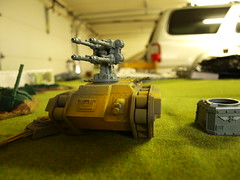
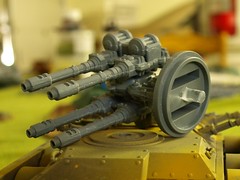
There's been a lot of talk about using the quad gun provided in the Aegis Defense Line for converting a Chimera into a Hydra Flak Tank. The Forge World version of the Hydra has a huge quad autocannon mounted onto the back of a Basilisk chassis. The quad autocannon in the Aegis box is only about half as big. This actually makes for an even easier conversion, although it doesn't look at all like the Forge World version. I'm calling it the Aegis pattern Hydra Flak Tank.

You start with the current Chimera kit, fully assembled, and an assembled quad autocannon from the Aegis kit. This assumes that you haven't somehow permanently attached either the turret on the Chimera or the quad gun to its Aegis base.

You're also going to need the bit of sprue from a flying stand, a 40mm, or a 60mm round base. The small cylindrical piece on the side that you have to clip off before using the base. Cut it from the base and use a file to make the piece entirely cylindrical, then glue it to the bottom of the round base of the quad gun. That's it.


Now you can simply remove the Chimera turret and replace it with the quad gun, and you can still put the quad gun back in its original base for use in the defense line, and the turret back on the Chimera for use as a regular Chimera.


Edit: I noticed shortly after posting this that I'd foolishly followed the directions in the box and assembled the barrels upside down. Fortunately, the glue hadn't set, so I was able to take the ammo canisters off and assemble it correctly. Something to be aware of in assembling the gun, but it has no bearing on the conversion.

Trees


I'm rather pleased with how my trees turned out. I did a bit of green stuff on the trunks to fill the major gaps before priming. I had started this months ago, but stopped because of how big a pain it was to prepare the green stuff. This was because it was old and stiff and required a lot of work to mix the two parts, once it was mixed it worked fine, but it simply took too long to get to that point. I finally broke down and got some new green stuff, and was able to finish up the work quickly.

For painting the base piece I followed the same process that I've done for my other terrain: brown base with ochre drybrushing and a mix of static grass on top. For the trees I started with the same brown base, but then used a heavy drybrush of Anita's All Purpose Acrylic 11084 Rainy Day Gray on the bark. I did the leaves on the sprue, using Anita's All Purpose Acrylic 11040 Hunter Green as the base with a moderate drybrushing of Anita's All Purpose Acrylic 11057 Spring Green on top. I then went and did the branches with the same technique I used on the trunk of the tree.

Assembling it is a bit of a pain, and the result is rather fragile. I don't plan on these leaving the house, so they should be OK, but if I were doing these for a store, or for transport, then I probably wouldn't bother with the leaves.

After assembling, I went back and touched up the leaves with the Hunter Green where I'd cut them from the sprue before hitting them with the matte sealer.

Wednesday, July 22, 2009

40K Stuff

I had posted on Facebook that I got my order of rare earth magnets in and was planning on magnetizing my Valkyrie model this past weekend. That didn't happen as I was still on a roll with terrain painting, so instead I got most of the job done on a set of GW woods (I'll write up how I painted them once I get some pictures).

It will probably be another few days yet until I get to the Valkyrie. Today I started back on a couple of Eldar models I'm hoping to have ready by Sunday. Why Sunday? It looks like Sunday is going to be 40K day at Castle House, and this Sunday we're starting our 'non-league escalation league.' Since most of the players are either new, or new to 5th Edition, most of us think it would be a good idea to start small with some 500 point forces to get things going, like in an escalation league, but without the actual league part.

I've already played a 500 point game with my IG, so I figure I'll switch to Eldar for this coming game. The main thing I need to do is put together another flying stand as I intend to use two Wave Serpents in my force, but I'd also like to get my Autarch painted in case I choose to use him as my HQ. That's what I worked on today, getting the base colors and wash done. Tomorrow I hope to finish it up and then hopefully do the basing on Friday.

I'm also expecting my Pig Iron heads to get here tomorrow, so I may end up getting distracted by IG, but I'll probably be able to stick with the Eldar for now.

My one concern about the 500 point 40K games is that they're talking about keeping it at that level for a couple of months, and I really need to boost it to 750 or 1000 to get a feel for what units I need to add to my Imperial Guard army. I just don't have very many options at 500, and feel like I'll be getting bored at that level, and not really learning a lot about my army. If they really want to keep it at 500 then I may have to put together a Space Marine list at that level in order to keep things interesting for me.