Monday, February 01, 2010

The Future of Retail RPGs

My friend over at Black Diamond Games has been musing lately about the future of RPGs from a retail point of view. Sadly for him and other retailers, I'm beginning to think that there isn't much of a future for RPGs in the retail market.

I've been saying for years that tabletop RPGs are destined to follow the same path as tabletop hex and counter wargames. Wargames got started in the fifties, grew in the sixties, and were really becoming a big deal in the seventies. In the late seventies and early eighties you could find Avalon Hill games in major bookstore chains and other retail locations, but in the early seventies something happened that was destined to cut short the popularity of wargames: tabletop RPGs.

Most know that tabletop RPGs grew out of wargaming (in fact, while D&D is the first published RPG its roots can be traced not only to Chainmail, but the unpublished wargaming/RPG hybrid Braunstein). Many people, in fact the majority of people, who had once been consumers of wargames, found RPGs to be more to their liking. The development of the personal computer further hurt the wargaming industry as those for whom RPGs weren't to their liking found that computer games often were. Computers could both streamline the handling of complex rules as well as provide an AI opponent, both big attractions for people dealing with games which were both hard to learn and difficult to find opponents for.

From a retail perspective, wargames were dying. First SPI disappeared, then Avalon Hill was eventually acquired by Hasbro, and today traditional hex and counter wargames are effectively dead in the retail market.

At the same time, there are more and better hex and counter wargames available today than ever before. New companies with different business models arose from the ashes of SPI and Avalon Hill. GMT Games, Multiman Publishing and Avalanche Press are the big boys, with a host of smaller companies also in the field.

They thrive in a market that sells directly to consumers, mostly over the internet. They still sell the occasional game in the retail market, but it's not their focus, and they seem to treat it more as a marketing expense than an opportunity for direct profit.

I think that RPGs are destined for a similar, but not identical, future. I think that we will see the industry go down two different paths. The first is being pioneered by Dungeons & Dragons and their DDI program. Whether or not it was deliberate, having so much information available online for a subscription is cannibalizing the sales of print products at the retail level. If this is not also cannibalizing the bottom line of Wizards of the Coast, then this trend will likely continue and may come to replace the "supplemental" model of RPGs that most "mainstream" RPGs now follow. This model involves the release of core rules followed by regular release of new content in the form of supplemental books until such time as it's felt that sales would best be served by a new set of core rules.

The second path is one of small press publishing, and more importantly, print on demand. The "indy" model where a game often consists of a single book, and where if additional books are produced their production is usually based more on what the game needs than on increasing sales. Few are likely to make their living designing games this way, but then few make their living designing wargames anymore either.

Small press games have always been around, but the availability of print on demand changes things. The difference between small press and mainstream used to mean the difference between a hardbound book and a bunch of photocopies stapled together (or bound with a plastic ring binding if it was "fancy"). Now the only difference between a print on demand book and one from a major publisher is the use of color, and maybe artwork.

I just received a copy of Diaspora, a game only available for purchase on Lulu, and its production quality beats anything that I've seen from mainstream RPG publisher Mongoose (admittedly the whipping boy in the RPG industry for poor production quality). Only the lack of interior color separates it from other major releases, and the creativity and editing quality is arguably far better than most.

Alternate paths, like that being followed by Warhammer Fantasy Roleplay, with its custom dice, are unlikely to start a general trend. They seem too gimicky, and are too obviously an attempt to solve problems with the business model through game design. If they were operating in a vacuum then they would likely succeed, but they're operating in an environment where others are simply abandoning the business model in favor of ones that work better.

Personally, I would like these alternate paths represented by Warhammer Fantasy Roleplay to succeed, because I think it's important that RPGs maintain a retail presence, both for the health of RPGs and the health of the retail game industry, but I suspect that they will instead become increasingly a niche within a niche.

Sunday, January 31, 2010

Mass Effect 2

I'm sure everyone in gaming is going to do a review of Mass Effect 2, but I'm still going to toss out my opinion as well. The short version is that this is a great game with very few flaws. It's got good game play (with one exception), a great story, good graphics, good voice acting, interesting characters, pretty much everything you need to make a good video game. If you want a detailed analysis of all those factors, then go elsewhere. I'm just going to cover the high points and the low points of the game as I see them.

First a little good news/bad news. The good news is that the most annoying mini-game from ME1, the driving around on planets bit, is gone. The bad news is that they replaced it with an equally annoying mini-game that forces you to scan planets for resources from orbit. This scanning is tedious and boring and unfortunately necessary in order to upgrade your gear. This factor is the only thing keeping ME2 from being one of the most re-playable games in recent memory (edit: see below for more info).

Fortunately, that's about the only bad thing in the entire game. There's a couple of minor quests that can take some effort to finish, but the solutions are out there on the web already if you don't want to waste a lot of time. There's also a couple of bugs, but nothing major, like one minor quest that won't clear from your log even after you complete it.

The biggest plus with this game is something that I can't praise enough: the autosave. Finally, someone figured out that pausing every few minutes to save the game isn't fun. This game autosaves seamlessly before every combat, and even between waves of many combats, to the point that I almost never felt the need to save my game for fear of having to run through the same series of combats again and again.

Of course, the autosave itself is not a new concept, but I've had so many experiences in other games where I get through a series of tough fights, barely making it, and then one more enemy pops out from an unexpected direction and kills me, forcing me to go all the way back to the beginning of the series of fights because that's where the last autosave was. That never happened in ME2.

Sure, there were some tough fights, and I died a few times, but I never had to go back and fight through hordes of enemies that I'd already defeated once just to get to the fight that I was having trouble with. The autosave almost always brought me back to the beginning of the fight I was having trouble with rather than forcing me to go through all those previous hordes again. At worst I had to go through one previous wave before getting to the hard one.

I hope every game designer out there is taking notes, because this implementation of autosave is pure awesome!

The rest of the game is pretty good too, and I highly recommend it, although I recommend the PC version if your system can handle it, if only because the planet scanning mini-game is slightly less annoying using a mouse than it is using the Xbox controller. At least it is if the comments from my friends playing it on the 360 are anything to go by.

Edit: I got around to starting a new character, and it looks like it gives you a rather large starting bankroll of resources, which may make playing the scanning mini-game less necessary. I haven't played too much into it yet, so can't tell for sure, but if so this would give the game far more replayability.

Second Edit: A friend of mine who has played further into his second game says that the starting bankroll of resources is nice, but there's not nearly enough to avoid having to play the scanning mini-game quite a bit during his second play through.

Tuesday, January 26, 2010

King of RPGs

I recently read the first volume of the American manga "King of RPGs" after seeing it mentioned on a couple of gaming sites. I thought it would be worth doing a review here.

It's been a while since I read any manga. I still watch some anime, but there really isn't much manga that makes it over here that interests me. There's plenty of manga written for men my age over in Japan (and I don't mean the pornographic stuff), but the manga that makes it over here is pretty much just the stuff written for teenagers. Admittedly, I haven't looked that closely at the available selection in a while, mainly because if there's one thing that makes me feel like a dirty old man it's hanging out in the manga section at the bookstore, so there may be some stuff that I've missed.

I decided to give King of RPGs a try because of the gaming connection. I'm glad I did, because I like it, but it isn't quite what I was hoping for. The big issue I have is how over the top everything in it is. Over the top slapstick humor is a staple of a lot of manga, but it's not a requirement. It's certainly not inappropriate to the genre, but it isn't a part that I appreciate all that much.

An example that shouldn't spoil any of the plot is the appearance of "the pit of commons" which is a basement of a game store filled with worthless CCG cards honed to "razor sharpness" due to friction over the years. Things like this only serve to take me out of the story due to their ridiculousness.

One other factor of the story bothers me, and that's the police officer who hates gamers and gaming. Checking the author's bio, I see that he's only a few years younger than me, so he probably remembers the bad old days when roleplaying was the chosen bogeyman of various authority figures. The problem is that those days are over. Including it is about as timely as including an authority figure out to stop that "devil music" that is rock and roll. The target of today's crowd of clueless authority figures is video gaming, not pen and paper RPGs.

Enough with what I don't like. There's a lot here that I do like as well. The characters are a fairly interesting mix. Another manga tradition is an ensemble cast where it's sometimes hard to tell just who is the main protagonist, and we have that here. The two top candidates are Shesh Maccabee, a recovering MMOG addict with a multiple personality disorder, and Theodore Dudek a wannabe "great gamemaster" who apparently hasn't ever actually done much gamemastering, but has spent his life collecting RPGs and learning gamemastering techniques (yeah, I can identify with both these characters, except for the multiple personality part...).

The supporting cast includes the MMOG addict's best friend, a fan of anime and anime games, including dating sims; a tomboyish girl gamer with a thing for ren faires; and a "gamer" girl who Theodore pays to play in his games to attract other gamers (and who is hinted to possibly hire herself out for other reasons, although I may be reading more into that then the author intended). There's also a number of characters that you'd expect to find in a college dorm or around a game shop that get a line here and there.

Antagonists include Gavin Slane who is only into games in order to make a profit off collectible items, and the aforementioned police woman who hates games and gamers. All of these main characters and antagonists are college aged, including the police woman who is apparently some sort of student trainee.

There are some great scenes, like when Shesh plays Gavin in a CCG and goes into "crazy RPG player" mode and we see the whole game go down in a narrative format with Shesh roleplaying his side of the game in his head. Similar scenes of the actual RPG sessions are equally entertaining.

There's lots of good references and in-jokes to gaming and gaming culture both in the dialog and the artwork. One such reference is to a rather infamous trick using the Chaos Orb card from the original Magic the Gathering release. The card was an extremely rare card that you used by throwing it up in the air, and any card it touched on landing was destroyed.

Speaking of the artwork, it's good. The artist handles both the "real world" and the fantasy scenes well, and packs a lot of good detail into many of the panels. The characters are well and consistently drawn, and have been designed in such a way that I never have any problems telling who is who.

Despite being a long time gamer, I don't think I was the exact target audience of this book. I think someone more into manga as well as gaming would appreciate it more, and I'd recommend it highly to any gamers who also consider themselves manga fans. Even with my reservations, I still plan on getting the next volume when it comes out.

Monday, January 25, 2010

Uncharted Seas - First Game

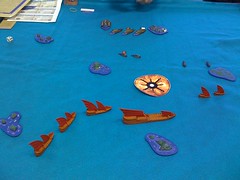
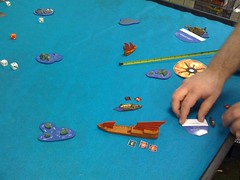
Dragon Lords vs. Shroud Mages 1/25/10
We had our first game of Uncharted Seas tonight, and it was fun, but I think I have an issue with the basic scenario.

It was my Dragon Lords vs. Jonathan's Shadow Mages in a "turn up and fight" scenario which is an equal point value matchup where the last man standing wins.

I scored first blood by getting a lucky critical early on against one of his cruisers, but it was downhill from there for my poor elven overlords.

We did have some cool incidents with the highlight being a great little fight where he crashed two of his frigates into one of my cruisers. One frigate sunk, but the other survived, and in the ensuing boarding action managed to achieve mutual annihilation, leaving both ships as derelicts for the remainder of the game.

Another cool incident came a bit after that when my last remaining frigate swooped into range of his battleship and set off a spell that left two fires raging on it. Unfortunately, the fires ended up doing little damage, but it was still cool.

It was at this point that I was pretty much out of the game. After the last frigate was duly dispatched for its impertinence in challenging the enemy battleship, I was left with two ships, both damaged, one of which only survived another turn before joining its companions at the bottom of the sea.

This was where things got boring for me. Knowing I was going to lose was not an issue, what was the problem was that I had nothing left to do. My opponent still had three squadrons left, and a total of five models. I had one squadron of one model, and it had already taken enough damage that I couldn't afford to split my fire. My turn took about two minutes to my opponent's ten at that point, and the game went on for several more turns before my last ship finally went under.

As it turned out, I was able to do some damage, and by the end of the game my opponent only had three ships left, one of each class, but that makes it sound closer than it was because his battleship was still nearly undamaged.

This lack of things for me to do for the latter third of the game is a problem with the scenario. The last man standing victory condition looks like it's going to result in this ending most of the time. Fortunately, there are other options. In addition to a couple of ideas in the rulebook, Craig Gallant over at the D6 Generation has come up with a few ideas on his site. I'll probably steal one of them for our next game.

There will be a next game. I like the system, I think it just needs better scenarios. It possibly also needs better terrain. I'd like to get some bigger islands made up for this, along with some other types of terrain.

It's also possible that a simple turn limit might do the trick, although I'm afraid that a fast fleet might be able to get in an early kill and then just play keep-away for the rest of the game. We might have to try it though, and see how it works.

Dragon Lords vs. Shroud Mages 1/25/10

Sunday, January 24, 2010

Dragon Lords

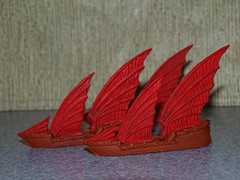
Dragon Lords Cruisers
As you can reasonably infer from my lack of posts about it lately, I haven't been doing much painting. Fortunately, I have a game of Uncharted Seas scheduled for Monday, and my opponent has already fully painted the fleet that he just received less than a week ago. That's spurred by lazy procrastinating ass to get busy on at least one of the three fleets I have had for over a year. Since my opponent has a Shroud Mages fleet, I decided to save my Iron Dwarf fleet for later, mainly so that any observers don't think that the game is only about ironclads. That left either my Dragon Lords or my Orc Raiders. Since the Orcs aren't assembled yet, it was an easy choice to go with the Dragon Lords.

I've always known that I wanted to do the Dragon Lords in bright colors, preferably reds given that I rarely work in that part of the color wheel. I also wanted to keep things simple since I only had a couple of days to finish the project if I wanted them ready for the game. Beyond that I really didn't have a plan going into the project. The end result is a bit of a fortuitous accident, but I'm quite pleased with it.

I started with the primer, a standard ruddy brown that I acquired specifically for this project some time ago. I originally thought that I might just primer the model, add a few details, and then give it a wash, but I decided to put a bit more work into it, and am glad I did. I ended up doing a natural wood color for the hulls almost by accident, using a brown that I thought might be a bit more reddish than it turned out to be. I then used a standard red for the sails, and washed it all with a dark brown wash after adding a few details.

The entire project only took three days. Primer was applied Friday morning. Friday evening I did up one frigate to see how it looked, and did a little work on a couple more. The bulk of the painting was done Saturday afternoon and evening, with everything done but the sealing by the time I went to bed. The only thing done on Sunday was to apply the sealer.

The paints I used are as follows:

Primer: Krylon Ruddy Brown
Hull: Vallejo Game Color 42 Parasite Brown
Sails: Vallejo Model Color 947 Red
Ballistae: Citadel Foundation Iyanden Darksun
Cannons: Vallejo Game Color 1 Chaos Black (I think that's what it's called, the bottle I'm using actually has a blank label)
Cabin Windows: Vallejo Model Color 915 Deep Yellow over Citadel Foundation Iyanden Darksun
Wash: Citadel Wash Gryphonne Sepia

Dragon Lords Starter Fleet