Tuesday, December 08, 2009

Play Unsafe

I've read a lot of essays about being a better roleplayer over the years, whether as a chapter in a rulebook, an article in a magazine, a post in a blog, or part of a complete book on the subject. One of the things almost all of these had in common was that they were aimed towards the gamemaster. They might occasionally suggest ways for players to become better roleplayers, but it was usually in terms of how gamemasters could help them to improve their game.

Play Unsafe is unusual in that it is aimed first towards the player. There's stuff aimed at the gamemaster too, and a gamemaster can get a lot out of the stuff that isn't aimed directly at him as well, but unlike most of the other things I've read, the focus is on the player.

The premise of Play Unsafe is to apply principles of improvisational drama to roleplaying. Not being familiar with those principles as they apply to drama, I can only evaluate how well the advice seems to apply to roleplaying, and I think it applies rather well.

The biggest theme of the book, aside from the obvious theme of being more improvisational, is to be more natural. It suggests that you simply react to events in a natural fashion and don't try to be too clever. Sometimes what seems obvious to you may be incredibly clever to others, but when you try to be clever you'll usually just come off as fake.

This theme is expanded upon in five chapters: Play, Build, Status, Tell Stories, and Work Together. The first chapter most directly elaborates on the basic premise, reminding you that you play to have fun, and that when you focus on that you'll play better naturally. Some sample subheadings include "stop working," "be average," and "be obvious."

The Build chapter focuses on building on the ideas put forward by others in the group as opposed to shooting them down and trying to replace them with your own.

The Status chapter describes the differences in behavior between those of high status and those of low status, and how that behavior can be used to enhance roleplaying.

The Tell Stories chapter describes a number of fairly simple tricks to help make your roleplaying tell a better story. Sample subheadings include "create routines and break them," "deliver on your promises," and "reincorporate." This chapter has a lot of similarities to ideas I've seen presented before, but they're presented in a very concise way with simple examples that suggest how they can be used more easily in an improvisational style game.

The final chapter, Work Together, is pretty much what you would expect. It's mostly about playing nice, but it also describes some ways to introduce character conflict while lessening the risk of player conflict being one of the outcomes.

At 82 pages total, with a large type font, and plenty of spacing, it won't take long to read through and digest this material. I think that's a good thing. The author presents a lot of ideas, but in a clear and concise manner. I would recommend this book to anyone with an interest in roleplaying.

Note that while I've linked to Lulu.com above, the book is also available from www.indiepressrevolution.com as I write this, and for slightly less. Either way, the cost will be around $20, which might seem a bit high for an 84 page digest size book, but I think it is well worth it.

Sunday, December 06, 2009

Episode Structure in Warhammer Fantasy Roleplay

Other than some organizational issues, and the lack of an index, I was really impressed with the core rules for Warhammer Fantasy Roleplay. As I get into the gamemaster book though, I'm running into some conceptual issues. Specifically the Episode/Act structure combined with Rally points. Now, there's nothing wrong with suggesting a structure for designing and running adventures, but by tying that structure into a game mechanic, the Rally Point, they make the whole thing a lot less flexible, and less usable with other structures a gamemaster might want to use.

The Episode structure is fairly straightforward on the surface. Adventures are divided into Episodes which are in turn divided into three Acts each. I'd explain what should go into an Episode and an Act, but frankly, I'm still a little unsure. The book gives plenty of examples, but I'm still having a hard time grasping just how those examples could be applied beyond the specific situations given in those examples. One example given is that each act could be a room in a building, but they're pretty firm on the three act structure, so what happens if I want a building with more than three rooms? Do I need to go through a three act episode every three rooms?

They even address this issue with suggestions that each room could be its own three act episode in some instances, but it really doesn't help in defining the nature of what should be considered an act and what should be considered an episode, and what should just be left as "story mode."

All this wouldn't matter if this was simply a set of guidelines that could be ignored or followed based on the GM's preference, but the problem is that the Rally Points are a game mechanic tied to the structure. At the end of every Act is a Rally Point, during which characters get a minor refresh to their abilities which prepares them for their next encounter. If you drop Rally Points you end up dropping abilities that only trigger during Rally Points, and potentially disrupt the balance of the game.

The whole thing seems to have been a poorly thought out system designed by someone who's taken too many drama classes. Drama and roleplaying have a great many things in common, but they also have a great many differences. Also, roleplaying has far more in common with the improv side of drama, whereas the rigid three act structure has more to do with the more traditional scripted side. There's a word for scripts in roleplaying, it's called railroading, and it's nearly universally considered to be a bad idea. No matter how much the book talks about the gamemaster being prepared to improvise, that advice just doesn't jibe with this Episode/Act structure.

Instead, it just comes across as something else that the GM has to worry about: is this and episode or isn't it? Should I end my act here or not? The GM already has a lot on his plate when running a game, and this just seems to be an extra bit of chore for him to have to deal with.

Fortunately, I see a way that I can adapt the Rally Point idea to my more improvisational style of gamemastering by ditching the drama model and replacing it with a model taken from computer games: the save point. Many of the examples of ending an act involve a change of scene, or the beginning of a confrontation with a major NPC. Whenever this happens in a computer game, the game often "autosaves" the game. By linking these autosave points to the Rally Point, I can more easily apply the concept to my own games, without having to deal with the rigid three act structure, and trying to figure out how it applies to the current situation.

Not that the three act structure is necessarily a bad idea, it's not, but it should be a guideline, not something tied to a game mechanic.

Friday, December 04, 2009

Warhammer Fantasy Roleplay: First Impressions

The new 3rd edition of Warhammer Fantasy Roleplay has proven to be controversial. Every new edition of an RPG is controversial to some extent, but the introduction of 3rd edition WHFRP has some extra issues. Before I go further I should state that I'm still reading the rules. This is very much a "first impression" and I may later post a "second impression" if further examination of the rules changes any of my opinions.

First, there's nothing wrong with 2nd edition. That's not just my impression, we're talking about an award winning system that was first published in 2005. Second, there were still books that could be published for the system. Particularly more books focusing on non-humans. Sales may have dropped, but from a fan perspective there are still a lot of things that could be done with the line. Third, in corporate speak, Fantasy Flight leveraged their expertise in board games to bring a new level of production value to the 3rd edition that scared people into thinking that they were making it into some sort of board game hybrid. Fourth, not a few people unhappy with the 4th edition of Dungeons & Dragons came over to WHFRP and they see 3rd edition WHFRP as being a move in the same direction that 4th edition D&D took.

Some of these concerns are valid, particularly the first one, but others are less so. The end result though is that while the core mechanics of the rules have changed, the core concepts and feel of the game seems to remain unchanged. Here's a list of some things that 3rd edition still has from previous editions: career based character progression, insanity rules, dangerous magic, you can start your career as a commoner, skill and talent based characters, hand weapons (sword, axe, mace, club, hammer, etc.) are functionally identical, and the overall background is the same.

Some of the things that have changed: no more d100, the core mechanic uses a dice pool with special dice; stats and skills have been simplified, although many of the old skills are still present as specializations of a broader category, such as pick locks under skulduggery; the game uses cards, but in practice this is simply taking what could have been put in the rulebook and instead putting it on a card that's easier to reference during the game; new systems for dealing with fatigue and stress; new system for having your character take aggressive and defensive stances; and combat is less tactical.

That last change is worth discussing more, if only because one of the complaints of 4th edition D&D is that it's too tactical, and because people have been afraid that Fantasy Flight was turning WHFRP into a board game. Gone is the battle grid. All that matters now is relative distance between characters and whether or not they are engaged. I love this. While I enjoy tactical board and miniatures games, and can enjoy tactical combat in RPGs, I prefer a more narrative style, and it looks like 3rd edition WHFRP encourages this kind of play.

That isn't to say there aren't issues. I'm still reading through the books, but I have found a couple areas of concern. The first is the lack of an index. With rules spread over four booklets, and the organization in each booklet somewhat spotty, the rules badly need a comprehensive index. It's really inexcusable for a set of core rules for a major RPG to be released without one. As already mentioned, the lack of an index is compounded by some poor organization of the rules. In the table of contents the topic of "Stances" is only listed once, but the actual rules for it are spread out over at least three areas, with no repetition of rules between those areas. This makes it difficult to find the rule you're looking for even when simply sitting down and browsing the rules. Finding rules in play will be nearly impossible.

Another issue is the narrowness of scope of the core rules in terms of characters. The race options limit you to a fairly limited area of the campaign world to start with. This will prove particularly problematical for anyone looking to convert an existing 2nd edition campaign to 3rd edition. Also, some of those races aren't very well fleshed out in terms of career options. There are no advanced careers for either type of elf, and only one for dwarfs. There are some elf advanced careers rumored to be coming in the first expansion, but it's unfortunate they weren't included in the core rules.

Still, I'm really looking forward to getting this on the table and giving it a try.

Thursday, December 03, 2009

RPG Afternoon


Board game night at Castle House Games is still going well. Attendance goes up and down, but we've got a core group of three players (including me), and another half dozen or so that come and go depending on their schedules and the games being played.

Miniatures are going less well, but only for me. Castle House is going strong with Warhammer 40K, and will soon hold their second tournament, but I have yet to regain my motivation for the game. It's been about two months now since I went in on a Sunday to play, and the only thing I'm interested in painting are my Field of Glory miniatures.

I've decided to try replacing my miniature gaming with roleplaying for a while. I've got some interest from the people in the board game night group in starting up an RPG afternoon on Sundays. This would give me a chance to run a series of one-shot adventures in different systems that I've been wanting to try out.

It's not that there isn't roleplaying already going on at the FLGS, quite the contrary, but it's largely of the "we're going to play for 8 or 10 hours starting at around 2pm" variety, which is something that simply doesn't fit into my schedule anymore.

I'm looking more at a 4 to 6 hour time slot where we wouldn't necessarily need to meet every week, and that simply doesn't exist right now, so that's why I'm going to try "RPG afternoon."

Candidates for inclusion in RPG afternoon include: 3:16, 3rd edition Warhammer Fantasy Roleplay, Dogs in the Vineyard, Spirit of the Century, Chronica Feudalis, and maybe Thousand Suns and some strictly one shot games like The Mountain Witch. If things go well with those, then I may try Mouse Guard or another Burning Wheel based game. By then I may have the RPG itch out of my system, or I may be looking to start a campaign of something. I might even be ready to get back into some miniatures gaming.

This is all still in the planning stages, and will probably have to wait until after Christmas to get started, but it's at least looking like a strong possibility.

They're Here!


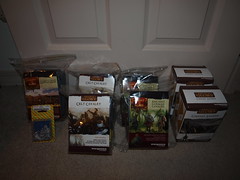
The rest of the miniatures for my army came today (well, yesterday, but yesterday only ended a few minutes ago as I post this), so I thought I'd post a "before" picture of the whole army. Of course, the boxes are empty now as I've been working on the legionnaires for a while. Everything is from Wargames Factory except the blister which contains some metal tribunes from Foundry Miniatures. I'm going to use those on my command stands.

The change in packaging is interesting. You can now see the sprues through the clear plastic, which is designed to hang from a retail display hook. The bags open at the bottom with a simple resealable fold (resealable glue, not a ziplock). The cardboard insert has very basic assembly instructions on the back, but no diagrams. Better than the original release, but not by a lot. Overall, I think I still prefer the original cardboard box, but the bag is probably more practical both for manufacturing and retail display.

I'm looking forward to assembling these guys, but I'll probably try to finish my legionnaires first, so this may be the last time you see them for a while.