Showing posts with label Dungeons and Dragons. Show all posts

Monday, August 13, 2012

Why D&D?

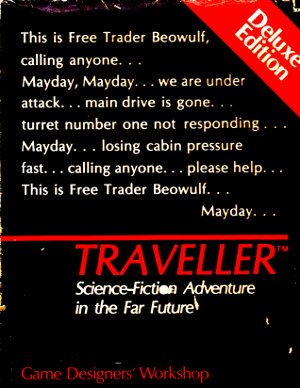
Dungeons & Dragons has never been my game of choice.  This goes all the way back to receiving my very first RPG, the D&D Basic Box with the Moldvay cover.  I liked the game a lot, but what I'd really been wanting was that boxed set of Traveller with the Free Trader Beowulf mayday signal written on the front.

It wasn't even my favorite fantasy RPG for long.  I was an early convert to both RuneQuest and Warhammer Fantasy Roleplay as fantasy alternatives.  I even preferred the Rolemaster derived Middle-Earth Roleplay.  Yet, today I have somehow managed to accumulate nine different core rules sets for D&D and its direct descendants.

This got me to thinking as to why that's the case.  The original reason is that D&D is what people play.  Whatever other games may be going on in a given gaming scene, there's inevitably at least one game of D&D being run.  Today that game might go by the name of "Pathfinder," but it's still D&D at heart.

Going back to college, which was my first period of regular gaming, every other game we played was D&D.  We played some Shadowrun, TORG, DC Heroes, and Star Wars D6 among others, but we always came back to AD&D because it was the one game you could always get a majority of our group to go along with.

Of course, that doesn't explain why I still have so much D&D in my collection today.  Now that I play with groups that have far more interest in other games I could easily do without D&D.  I could claim that it was all leftover from my college days, but that would be a lie.  I actually got rid of most of that stuff during my great gaming "drought" in the years after college.

The main reason I have for having D&D today is that for all its flaws, it works.  The classic six stats with level based advancement, hit points, and Vancian magic is something that most gamers seem to instinctively grasp.  When stripped to these essential elements the game plays fast and fun in ways that many other systems ultimately fail to do.

I find this less true of more recent iterations of D&D (3.5, Pathfinder and 4th), where I find the emphasis is more on character "builds" than building characters, but that was a discovery I made only slowly and that eventually brought me around to the games of the Old School Renaissance (OSR), my favorite example of which is Swords & Wizardry.

I'm even planning on running a game of Stars Without Number soon, a sci-fi game that uses the OSR rules as a base.

So, while D&D might not be the best simulation, or have the most evocative setting, or the best set of rules to encourage roleplay, it's still a good game.  Something that only took me a couple of decades to fully acknowledge.

Sunday, July 10, 2011

D&D Essentials: An Evaluation

I originally wrote this last year, but never posted it. It's interesting to note that since I wrote this, Pathfinder has passed D&D in sales, at least in some locations.

D&D Essentials have now been out for a while, and I've had the chance to look them all over, so I thought I'd give my overall impressions of how the line has done in meeting its goals.

The first step is to establish just what the line was meant to do, as it's not entirely clear. It appears that it was meant to establish a more friendly starting point for new players, but there's also evidence that it was meant to try to create a "feel" that would appeal more to players of older editions that have complained that 4th Edition D&D is too different from those editions. I think that the Essentials line has had mixed success on both counts.

I've touched briefly on the new "red box" before. As a standalone introduction to the game it's fine, but then becomes worse than useless as gamers transition into the rest of the Essentials line. Someone made the boneheaded decision to go to press with the red box before finalizing the details of the two players' books: Heroes of the Fallen Lands and Heroes of the Forgotten Kingdoms. As a result, characters created with the red box are incompatible with the latter books. This is a complete waste, making a lot of the nifty player aids provided in the red box useless outside of it.

To make matters worse, the issue is barely touched upon on in the rest of the line, aside from a mention somewhere that players should rebuild their characters if they are using ones created with the red box. Epic Fail.

Seriously, when creating a line meant to introduce new people to the hobby things should be as seamless as possible. If you had wanted to set out to design something as unfriendly to new gamers as possible, it would be hard to come up with something "better" than this.

It's a real shame, because despite some other criticisms of the line, it's pretty solid once you get beyond the "red box".

Enough on that though, lets move on and evaluate the rest of the line.

One interesting decision when laying out the line was to have a great deal of repetition between products. It appears that WotC has sought to cut down on the number of books required by each player to have at the table, or even to own. To that end, a lot of the rules to be found in the actual Rules Compendium (the core rules for the Essentials line) can be found repeated in the other books in the line.

Both "Heroes" books have around a hundred pages of rules covering the basics of play, character generation, powers, and skills that are covered both in the Compendium, and repeated word for word between the two Heroes books. Note the hundred pages of repeated content, because we'll come back to that later when we discuss some things that are missing from the line.

The Dungeon Master's Book from the Dungeon Master's Kit also repeats about a hundred pages of rules from the Compendium, although largely a different set of rules than those repeated in the Heroes books. Altogether that's over 300 pages of repeated material in the line, and the books average 300 pages each!

It's sort of nice that players only need to have a Heroes book with them in order to have both character information and basic combat and skill rules at their fingertips, but given the small size of the Essentials books overall, I don't think it would be a great imposition for them to have had to have both a Heroes book and a Compendium, or even both Heroes books and the Compendium.

This crossover between the books also makes it a bit unclear as to just what is needed to play the game. It appears possible that the Dungeon Master's Kit and one of the Heroes books together contain everything needed to run some basic adventures, especially pre-published ones, however, there are some additional rules in the Compendium not reprinted in either the Dungeon Master's Book or the Heroes books, so eventually someone is probably going to want to get that. It's not clear when that point might be though. Surely none of the books point it out.

We'll leave that for now and take a look at the other purpose of the set: the nostalgia factor. This is the attempt to get fans of older editions of the game to take a look at the new version. I think this is pretty much a lost cause as long as Pathfinder is out there, but let's take a look at it anyway.

The red box creates a huge feeling of nostalgia, but this is probably becomes more of a negative once people get past the red box and realize the issues of compatibility I mentioned before. It just makes it more likely they will get fed up with WotC for screwing things up yet again and go back to Pathfinder or Swords & Wizardry.

Skipping the red box and moving on to the Heroes books, there's a bit more success. The classes in Heroes of the Fallen Lands are iconic. The Knight feels like a classic fighter, the Warpriest feels like a classic cleric, the Thief feels like a classic thief, and the Mage feels like a classic wizard. The four together capture the iconic core of a classic D&D adventuring group. The fifth class: the Slayer, captures the feel of the more reckless classic fighter, but doubles up on the Striker role with the Thief. This brings up one of the issues with the Heroes books as a whole: four Striker classes compared to two each of the other three. Plus the "bonus" class available from D&D Insider is also a Striker.

The Compendium says that it's a good idea to cover all roles, but we have over twice as many choices for the Striker role as any other! Is the Striker an OK role to double up on? Maybe, but it doesn't say that anywhere in Essentials.

The races in Heroes of the Fallen Lands are also the classics, with Human, Elf, Dwarf, Halfling, and Eladrin. OK, Eladrin are not classic in the sense that they did not exist in prior editions, but they were basically one of two ways that Elves were interpreted in the game, so in that sense they still fit.

Moving on, the classes in Heroes of the Forgotten Kingdoms are less attractive to me personally, but seem to do a good job of capturing a more classic feel. The Hunter captures the ranger that combined both martial and magical abilities that appeared in previous editions of D&D. I actually prefer the more purely martial take that the 4th Edition PHB takes, but that's admittedly a change from previous editions. The Scout is Drizzt, and while traditionally Drizzt broke the rules of D&D, I suppose that for many he represents what D&D should feel like, so I suppose it's appropriate to include the ability to play him here.

I've never been a big fan of druids, but the Sentinel seems to represent them fairly well. Same goes for the Cavalier. The Hexblade seems to be an oddball. Again, I'm not a huge fan of warlocks, but this seems to be a particularly specialized kind of warlock, whereas most of the other classes seem to be meant to be more generalist in their nature. I suppose the problem may be that the PHB already does a good job of capturing the classic feel of Warlocks.

The races presented are OK. In the name of repeating stuff we get Humans again, we also get the half-elf, half-orc, dragonborn, tiefling and drow. These choices are more to round out what D&D is today as opposed to the classic feel of previous editions, especially with the presence of dragonborn and tiefling. Also, drow PCs to me are what dragonborn PCs are to the generation that grew up largely with 3rd Edition: an abomination meant to be a sop to teenagers with power/emo issues. So, I'm a bit prejudiced against this volume of Heroes. Overall I think it does a decent job at what it sets out to do.

A problem with both Heroes books is what they leave out. The Warpriest has domains, the Mage has schools, the Cavalier has virtues and the Warlock has pacts. The problem is that while there's obviously potential for more, the Heroes books only present two of each. I suppose this may be in the name of keeping things simple, but it really just feels incomplete. We now come back to those 100 pages wasted in each book repeating rules from the Compendium. Those pages could have instead been used to give us a complete set of options for these classes.

That leads us to the one book we haven't touched on yet: the Monster Vault. Overall this is a nice volume, but it's not nearly as flexible as the Monster Manuals because no where in the Essentials line are rules for altering the level of monsters, or for monster templates. Now, it was a pretty easy cut to make things simpler, but it results in far less utility. We return to the waste of pages in the Dungeon Master's Book where we repeat about a 100 pages from the Compendium again. That space could have been used to put the rules for tweaking monsters and would have gone a long way to making the Essentials line more useful.

So in the end, are the Essentials essential? The answer is no. They just muddy up the whole picture as to what you need in order to play with no clear line drawn as to where to go when you want more. For example, DMs can go to the DMG if they want to be able to tweak or create new monsters, but there's nothing in the Essentials line that tells them that.

I think this was a noble experiment, but that it missed the mark. I'm glad they did it because the Dungeon Master's Kit, Monster Vault, and Dungeon Tiles Master Sets are a great source of counters and maps for use in my Pathfinder game, but it could have been so much more. I can only speculate as to what went wrong and why, but it's enough to know that an opportunity has been missed.

Tuesday, July 05, 2011

Freeport

Take one part Lankhmar, one part Sanctuary, and one part Port Royal, mix in some Dungeons & Dragons and season with some Cthulhu Mythos and you end up with Freeport. I'm a relative newcomer to Freeport, a setting originally created for Dungeons & Dragons 3rd Edition. In fact, Death In Freeport was one of only two d20 books released on the same day as the 3rd Edition Player's Handbook back in 2000 (that's according to Green Ronin, the company that publishes Freeport).

The setting developed over the years with a number of adventures and sourcebooks until the approaching 4th Edition of Dungeons & Dragons, with the accompanying changes in licensing, caused the folks at Green Ronin to divorce the system from D&D and make it a systemless setting designed to either be used on its own or dropped into another world at the choice of the people using it.

As a result they produced The Pirate's Guide to Freeport, a system neutral setting book describing the city, and to a lesser extent its immediate surroundings as well as the overall world it exists in. Since then they have released a number of Companion books that provide rules to adapt the setting to different systems, including True 20, D&D 3.5, Savage Worlds, Castles & Crusades, Pathfinder, and D&D 4th Edition (although this last is from another publisher, apparently for legal reasons).

I have the Pathfinder Freeport Companion, but haven't really looked at it much yet, and I'm not sure I'll ever use it. I'm not really sure it's that necessary, although it does offer rules for gunpowder weapons and other things that aren't in the Pathfinder Core Rules, so it would probably be nice to have if running Freeport in Pathfinder.

The reason I don't think the Companion is all that necessary is that the setting stands on its own even without detailed stats, and should be useable in any D&D inspired game system with little work, and any Fantasy RPG with just a bit more creativity. The city is predominantly human, but has representatives of all the other standard fantasy RPG races: dwarves, elves, gnomes, and halflings as well as goblins, orcs and hobgoblins. It also has one or two unique races that could be easily statted up, or simply left out.

The fantasy elements are really well done in that they offer flavor without being so specific as to make it difficult to insert them into a different world. For example, there's Bloodsalt. Bloodsalt is the goblinoid ghetto where all the orcs, goblins and hobgoblins have been forced to relocate. There's a plot hook involving the animosity between hobgoblins and orcs, but if you don't have hobgoblins in your world it could be two rival orc tribes instead. If you don't have goblinoids at all it could be some other sort of ghetto. The point is that in most places where the setting involves racial distinctions, it should't be too difficult to tweak things if those races aren't in your world, or they behave differently. Part of what makes this easy is the very lack of system specific details.

In fact, the ease with which one element can be dropped out of the mix without messing up the rest of the picture is probably the setting's biggest strength. Everything works together, but most elements can be taken out or ignored without causing gaping holes in the logic of the rest of the setting.

The biggest problem I have is the pantheon of gods in Freeport, and it's because they took this idea of interchangeability a bit too far. At some point they decided to leave the gods unnamed. They just say "god of war" or "god of the sea" and let you fill it in with the most appropriate god from the setting you're dropping Freeport into. There are two problems with this. The first is that if you're not dropping it into a setting at all, but using the default Freeport setting, then you have to come up with names and other details on your own. The second is when the details of the pantheon for the setting you're dropping it into doesn't match up with what is needed for Freeport.

There are only four major gods worshiped in Freeport: knowledge, war, the sea, and pirates. The first problem is that out of several established fantasy pantheons I've gone through only one has a god of pirates. The second problem is related to the fact that there are at least another eleven gods mentioned in parts of the text (not counting silly gods, like the god of hinges). That's fifteen gods total. Most fantasy pantheons I'm familiar with simply don't have that many gods.

It would have been more useful if they had gone ahead and named the gods. Those gods could still be replaced with ones more appropriate to the setting you're dropping it into, while providing details for any gods that don't appear in that setting.

Still, it's a minor point in an otherwise excellent setting. I'm unlikely to ever use it as it stands in my own games, but I've already been inspired by it to create a short Burning Wheel adventure featuring pirate characters based out of a similar setting. If you like reading about original fantasy settings then you should check out The Pirate's Guide to Freeport.

Wednesday, September 08, 2010

Another Quick Word on D&D Essentials

I see one big missed opportunity with the new Red Box: 1 on 1 play.

In order to describe what I'm talking about, let me give you a little personal history. My first RPG was the predecessor to the original "red box", the version I call the "purple box" with the Erol Otus cover. My first GM was my mom, and my first adventuring party was, well, me. I was an only child and we were on vacation at my grandmother's house when my parents got me the game, so there was no one else to play.

My mom used the very basic dungeon creation rules to create a random adventure, the details of which completely escape me, but thirty years later I'm still playing RPGs so it must have been interesting at the time.

The new "red box" starts with a solo adventure, which could be run by a GM for one player easily enough, but it then jumps to an adventure written for a GM and four players... WTF? Isn't this supposed to be aimed towards people completely new to the hobby? How often do five people, completely new to the hobby, just happen to get together to play a game? I think that something similar to my personal experience is much more likely to happen.

Now, it can be argued that a DM can scale the adventure, or that a player can play more than one character, but that misses the point that this is supposed to be for completely inexperienced gamers. Scaling up an adventure is generally easier than scaling down. Write an adventure for one player, and if there's two it's just a matter of tossing in more monsters. Write an adventure for four, and if there's only one you've got to completely redesign any "big bads" in the adventure. That's not something a DM completely new to the hobby is going to feel comfortable doing, especially not with the minimal guidance given in the material included in the new Red Box.

Maybe my personal experience is a thing of the past, maybe with roleplaying more widespread it's easier to find a group and so this isn't a big deal. I disagree.

Back to my personal experience, this time some of my first impressions going through the new "red box". As I'm looking at the stuff in the box it dawns on me that this might be something I could get my non-gamer wife to try. The whole thing with the cards and map and tokens might just be something she'd be willing to play with. Then I look at the main adventure that's designed for four players and I set that thought aside with a sigh. Another missed opportunity.

Tuesday, August 31, 2010

A Quick Word on D&D Essentials

I picked up the new "red box" the other day and have been looking at pictures of some of the upcoming releases in the "Essentials" line, and I think they've finally figured out how to deal with one of the biggest barriers to entry since the introduction of 3rd Edition Dungeons & Dragons: miniatures.

Prior to 3rd, miniatures were an option, and I don't think I ever used them in a game. With 3rd they were a requirement due to the changes in the combat rules, and remained so in 4th. The game always mentioned the idea of using tokens or something else if you didn't have miniatures, but marketing considerations always made them emphasize the miniatures you could get from the D&D collectible miniatures game, and prevented them from providing a more affordable alternative. Now that that game is dead, they're finally free to offer a serious alternative for new players.

The "red box" includes a sheet of full color circular tokens representing both monsters and heroes. It also includes a two-sided full color map. From pictures, I can see that the upcoming DM's kit includes at least three more counter sheets, and a couple more maps. Then the Monster Vault includes ten sheets of counters, presumably with multiples for every monster in the "vault", as well as at least one more map. Add in the new Dungeon Tiles Master Sets that they plan on actually keeping in print, and people new to the game will be able to acquire a sizable collection of full color counters and maps for a reasonable price.

That's a big deal.

Tuesday, June 30, 2009

Dungeon Delves Update

A while back I played in a couple sessions of the local Dungeon Delves group at the FLGS. Since then I've often been playing miniatures games on the nights the Dungeon Delve group meets, but even when I haven't been I've skipped the Dungeon Delve. The reason is simple: pre-gens. A couple of weeks ago the people running the group decided to switch to pre-gens for the games. It's understandable why. They were seeing increasing amounts of time being wasted in pre-game prep as people came unprepared to play, and this was only going to increase as the levels that the adventures were designed for increased.

The problem is that character design was pretty much the last vestige of actual roleplaying that existed in what was essentially a scenario based miniatures game. Now that even that element is gone, I see little reason to participate, despite the fact that the people running it seem like a great bunch of guys.

The thing is, if I wanted to just play a scenario based miniatures game, there are better options out there. Descent is a big one, and one I happen to own. In fact, from what I've heard, Descent with the Descent: The Road To Legend expansion sounds like it has more roleplaying elements than the dungeon delves, with more player choice.

This isn't meant to be a rant on the game, or the people running it, just an expression on my part that it's not currently what I'm looking for, and an explanation as to why I haven't mentioned it recently.

Wednesday, April 15, 2009

Heroic Death

My character died in his second adventure. Who knew that a low constitution, ranged striker that always finds himself in the front line would be vulnerable? It wasn't the healers' fault, I simply ran out of healing surges followed by an attack that took me to exactly my negative bloodied level.

Fortunately, the style of campaign we're running is very forgiving. The Knights of the Arasen Vale (the organization our characters belong to) offer free raise dead rituals to those who fall in the line of duty. My only "death penalty" being the loss of half the xp and cash I would have earned in the encounter I died in.

I still like my character, and I'm 90% sure I'll continue to play him, but there are a couple of concerns both in my build and in the way the game plays. I probably should have dumped at least a couple more points into constitution at the expense of strength. I'm really not using my strength score, and I simply took the recommended defaults that the character builder gave me since I had never played before.

The problem with the way the game plays is that the character really isn't supposed to be in the front line. He ends up there because everyone else is even more squishy than he is, even the other striker in the group (who is also ranged). It also doesn't help that he's designed to move, but we inevitably start encounters in a 2x2 square area that's only open to the front. This is a result of the encounter based setup of the campaign. Each encounter is basically restricted to an 8.5x11 sheet of paper for convenience, but it makes for some very constricted battlefields. That's OK for some encounters, but it really hurts my character when every encounter is like that.

The result is that I inevitably get pounded on even in the easier lead-in encounters, where I have to take opportunity attacks in order to attack simply because there's no place for me to shift to. For now I'll just deal, but I may have to say something if we continue with the "elevator" approach to each encounter (we're effectively entering each encounter in a small elevator car where we can only go forward).

If I do have to roll a new character to better account for the encounter based style of play it will be a real shame because I've been looking forward to playing an effective archer in an RPG since I first picked up the purple box basic D&D. These two sessions have proven to me that the archer is effective, he's simply limited by the current play situation, as well as some mistakes in my build.

As for my character's death, I knew it was coming so I was able to get my daily power off and do a bit of damage the turn before it arrived. The remaining members of the party were able to dispatch the surviving foes in just a few more turns, with only the warlock leader, the one who killed me, managing to make his escape.

Tuesday, April 07, 2009

Finally!

I finally got to sit down and play a game face to face with someone, and it was 4th Edition D&D, which I have been itching to try out since its release.

My initial impression is that I understand the naysayers, but still respectfully disagree. It's true, the game does not encourage roleplaying in the way a game like Burning Wheel might. It encourages tactical thinking and teamwork, but it still allows for roleplaying. It's simply up to the DM and the players.

I want to start by saying that the game tonight was well run, and was delivered as advertised: three encounters in three hours using 4th edition D&D. I had a great deal of fun and really got to see the rules in action.

Now, the game tonight was also a perfect example of what the naysayers have been complaining about. The game started in media res, with the players having already accepted the mission, and finding themselves outside the gate of their destination. There was no debate or negotiation. No investigation or exploration. We were there to do a job and we proceeded to do it.

The rules make this kind of game very easy to set up and run, but it's still the DM's choice to run it that way. If we had had more time than the three hour slot we were given, we could have started the game at the beginning. We could have played out being recruited into the Guard in order to investigate a case of missing Dwarves. We could have questioned those with knowledge of the situation to better prepare ourselves, and then gone out and explored the area where the Dwarves were last seen. Instead, all of this was made part of the introduction, either implicitly or explicitly, and we began the actual game with the first combat encounter.

In many ways, this is a return to the roots of D&D as an outgrowth of a tactical miniatures wargame, and I guess it's going to take some players a while to realize the potential for roleplaying within the system.

Of course, some players may simply get tired of the system itself and move on before they realize that potential, and I don't think there's anything wrong with that either. There are systems that encourage roleplaying more than 4th Edition D&D, and here's where I tend to disagree with most of the naysayers: 3rd Edition D&D isn't one of those games. It's still a system centered around tactical combat.

All that aside, I'm looking forward to the next session.

Wednesday, March 18, 2009

D&D Rant

Disclaimer: I have yet to play a single game of 4th edition D&D. I played in less than a dozen sessions of 3.5. I played quite a bit of 2nd edition, a little bit of 1st, and the first RPG I ever had was the "purple box" D&D Basic. I mention this to establish my D&D 'cred' or lack thereof.

Recently someone on another blog interjected this gem into the comments on a post about D&D 4th: "Here's an idea, go back to running old school D&D games that were free form and far less limited by 600 pages of rules!!"

I replied to that post there, but I want to repeat that reply and expand upon it here:

Really? Which version of D&D was this? I must have missed the "free form" edition.

D&D has never been "free form," and every edition has had far more than 600 pages of rules spread out over the different books.

I think it's funny that nearly every argument I've seen against D&D 4th are ones that I've used in the past against any edition of D&D in favor of other systems.

Seriously, if you want a rules light "free form" system don't play D&D! There are, and always have been, far better systems out there if that's your thing.

While we're on this track, let me shoot down another argument that's often made. D&D has never encouraged roleplaying. Your DM may have encouraged roleplaying, but the system never did. Arguing that you play an older version of D&D because you're a "roleplayer" is about the dumbest thing you could ever say.

Again, if a focus on roleplaying is truly your thing, then there are, and always have been, much better systems in terms of encouraging roleplaying out there. In fact, just about any RPG ever made does a better job of encouraging roleplaying than any edition of D&D ever has.

I think part of the reason I like D&D 4th is that I'm not a roleplayer, I'm a gamer. I like games, and I like new games because they are often better than old games because game designers often learn from the mistakes of the past.

D&D 4th looks like a great game. The rules are tight and balanced. A new player is faced with a limited number of options that expand as they play the game and their experience with the system grows. New DMs are given useful guidelines in designing encounters that will challenge the players without overwhelming them.

That's not to say it doesn't have problems. Out of the gate it suffers from fewer options than 3.5, but that's to be expected of a new system that only has a few hundred pages compared to the tens of thousands written for the older ones. I've heard complaints about the 'missing' 'core' classes and races, all of which have been reintroduced with the PHB2.

I suppose the kind of gaming groups that play every week and finish a campaign in two or three months could have run up against the limited options available at launch by now (and evidence indicates that many of them have), but those options are expanding, and will continue to expand as new books come out. In the meantime, maybe some of those groups could try games other than D&D?

While not true in all cases, I've noticed that the majority of complainers either play D&D exclusively, or it at least makes up the majority of their gaming. Gamers that play a variety of RPGs, or just more games in general, seem to see 4th edition as an improvement over the past. Perhaps if some of the naysayers would broaden their minds a bit beyond D&D, or RPGing in general, they too would come to see the good things in 4th edition.

Then again, maybe some of this hate is for the best. Just yesterday I was talking to someone who has become disenchanted with D&D 4th. They were telling me about this new game they'd found that they like a lot better called the Burning Wheel...

Tuesday, December 09, 2008

To the 3.5 Diehards

If I play D&D it's going to be 4th Edition, but if you still prefer 3.5 then you should check out Monte Cook's Collected Book of Experimental Might. Previously available as a pair of PDFs, this is a collection of house rules by Monte Cook that could arguably have become 4.0 in an alternate universe.

I have the first of the PDFs which I bought as a hard copy from a print on demand service. It does a complete overhaul of the magic system while still retaining the Vancian core. As I understand it, the second PDF did something similar for the non-magic classes by revamping the feat system. If it was half as well thought out as the magic then the combined book should be extremely useful for anyone who didn't get what they were looking for from 4th Edition D&D. At $29.99 it's not a bad deal either. I paid that for just the first half of it! If I thought that there was any chance I'd ever want to run a 3.5 game I'd buy it.

Thursday, December 04, 2008

Quick Impressions

I've been glancing through a lot of RPG stuff recently, but haven't had the time to go through any of it with the level of detail needed to do a full review. Instead I'm going to give a few comments here covering things I noticed so far and wanted to share.

King of the Trollhaunt Warrens: It's not set in the Nentir Vale, and doesn't make any effort to connect to the H series of adventures. I expected the H, P, E series of adventures to be more of a level 1-30 campaign, not a set of largely unconnected adventures that just happened to go from levels 1 to 30. There's at least a suggestion of what direction the setting lies from the Nentir Vale, but I think more could have been achieved here.

Martial Power: Rangers rock. I was already a big fan of the Archer ranger and they get some interesting new paragon paths, but the Beastmaster ranger is going to make my choice difficult if I ever get to actually play. The only drawback to this book is that by adding even further options for Defenders, Strikers, and Leaders, it makes the Controller role look even more straightjacketed. Hopefully the Arcane Power book will give Wizards at least a couple of new builds, if not a completely new Controller Class or two either there or in the PHB2.

High Guard: I open the book and the table of contents is for Mercenary. Come on guys! You were doing so well, don't pull a Mongoose and blow it. Your brand is rapidly becoming synonymous with poor quality control, whether it's in editing or production.

It's a shame, because the content seems pretty good (aside from a good deal of further errata). The deckplans for the capital ships are interesting and something that has been largely missing from Traveller, but why change canon unnecessarily? There's already an established set of plans for the PF Sloan, yet someone felt the need to completely alter the shape of the ship and create new ones.

It was nice to see the plans for a superfreighter included. Hopefully we'll see more of that if there's ever a Merchant book done.

Scum and Villainy: I think that Star Wars Saga Edition may be the most consistently good RPG product line out there right now. Although it got a slow start due to the resources being devoted to the launch of 4th Edition D&D, every release that has come out has had something for everyone, players and GMs alike. Even the weakest book, Threats of the Galaxy, still had a number of new talents, equipment and playable races scattered through the book. It may be a good thing that I'm not running a Star Wars campaign, because each book that comes out makes me want to run a campaign based on it. So far we've had the Knights of the Old Republic setting, the Dark Times setting in the Force Unleashed, and now the Fringe setting in Scum and Villiany.

I haven't had much time to actually read Scum and Villainy yet, but among other things it's got rules for smuggling, bounty hunting, equipment modifications and Jawas. I am so playing a Jawa if I ever get into a game.

Friday, October 03, 2008

The Forgotten Realms in 4th Edition

Every change to a new edition of an RPG generates a lot of controversy in the fan community. Perhaps the most controversial changes to come with 4th Edition Dungeons & Dragons have been the changes to the Forgotten Realms.

While I sympathize with fans who feel the changes were too much, I not only disagree with them, but I think that the changes didn't go far enough.

The Forgotten Realms were created for 1st Edition Advanced Dungeons & Dragons, and have always had a 1st Edition mindset. They were created using the 1st Edition rules as a foundation and asking the question "if these rules were the laws of reality, what would the world look like." When they made the change to 2nd Edition AD&D they put the realms through a series of cataclysmic changes in order to explain the changes made in the rules, because they recognized that the rules defined the setting for the Forgotten Realms.

Now, with 4th Edition, they decided to do something similar. If it took a cataclysm to make the relatively minor change from 1st to 2nd, it was going to take something even greater to make the change from 3rd to 4th seeing as how the changes to the rules were so much greater. That's why we get a world where entire continents have been replaced, civilizations have fallen and risen, and the timeline has been advanced 100 years.

The problem is that they didn't go far enough. The 4th Edition Dungeon Master's Guide lists nine assumptions about the world. One of those assumptions is that "Adventurers Are Exceptional." That has never been true in the Forgotten Realms. Adventurers in the Realms are so common place that countries like Cormyr have laws and regulations specifically to deal with them, and sometimes construct national policy based on the presence of adventurers and what they are likely to do. This was true before, and it's still true even after the 4th Edition updates.

The Forgotten Realms does meet the other eight assumptions, and the DMG talks about altering core assumptions, but to allow the first fully supported setting in the new edition to break what is arguably the most important of the core world assumptions was a mistake.

The "Adventurers Are Exceptional" assumption is what most sets 4th Edition apart from its earlier incarnations. Playing in the Forgotten Realms of previous editions, players didn't usually feel that their actions made much of an impression on the big picture. There was always someone more powerful just around the corner. This meant that either the players never dealt with significant threats, or else there had to be a reason why Elminster, or one of hundreds of other powerful adventurers, wasn't already dealing with it.

While 4th edition has done away with a large number of the more powerful NPCs, and reduced the power of some of those that remain, it still retains the idea that adventurers are everywhere, and therefore not really that exceptional.

I think they had their reasons for doing this. The first is that they probably agree that the "Adventurers Are Exceptional" assumption is the biggest change from previous editions, and by putting out the Forgotten Realms without that assumption they hoped to provide a setting that was a little more familiar to those coming from previous editions. The second reason is that the Forgotten Realms are the setting for the first "living" campaign for 4th Edition put on by the RPGA. The living campaigns, by necessity, assume that adventurers are relatively common. They have to in order to accept that hundreds, or even thousands, of players across the US and the world are all playing characters in the same shared campaign.

Still, I would rather have seen a setting that more fully encompassed the core setting assumptions at the heart of 4th Edition, and I fear that by not doing so the design teams could lose sight of some of those assumptions. That would be a real shame.

Thursday, September 04, 2008

Podcast Goodness

I'm using my new iPhone a lot. Not as a phone though. Instead, I'm using it far more often as an iPod and a pocket computer. My most common activities are checking email and listening to podcasts.

I've found myself with about eight hours each week behind the wheel taking my wife to work, so listening to podcasts has helped me to keep my sanity when she's not in the car.

I started with some World of Warcraft podcasts, with my favorite being The Instance. These guys seem to know what they're doing while still acknowledging the existence of casual players, and it's an entertaining listen, although it's fallen off the top of my list since I entered the post 70 blues.

After listening to some WoW podcasts, I decided to branch out into some podcasts for my other hobbies. Specifically, I started checking out some D&D/D20 podcasts and some Warhammer podcasts. My favorites right now are Radio Free Hommlet for D&D and 40k Radio for Warhammer 40K. I'm also interested in RFH's sister Star Wars Saga Edition podcast Order 66, and the Warhammer Fantasy Podcast Podhammer, but I've only listened to one episode of each of those so far.

I'm also going to add 40k Warcasting to my list. They do complete army book breakdowns, and their recent Eldar breakdown was impressive, even if it did miss a few points I've gotten from other sources. Also, one of the guys appears to be a retailer, which adds some extra insight into an area I have some interest in. Unfortunately, their posting is a bit more sporadic than the other podcasts I've mentioned.

An honorable mention goes to the Penny Arcade/PvP/WotC D&D play sessions featuring Tycho and Gabe from Penny Arcade and Scott Kurtz from PvP running through portions of Keep on the Shadowfell. A couple of guys from WotC serve as DMs (the first session has Chris Perkins, and James Wyatt takes over for the second session). Tycho and Kurtz are veteran RPGers, and Gabe is a longtime video game geek, but new to RPGs. All three of them are new to 4th edition, so the dynamics are interesting. Listening to them play really made me want to play myself. You can tell they were having a blast despite having some of the crappiest luck with the dice ever in the second session. You can currently find them here, but the WotC site still pretty much sucks, so who knows how long that link will work. There are eight episodes and the guys added a couple of pieces of artwork to each episode featuring memorable quotes or scenes from the episode.

Tuesday, September 02, 2008

Pyramid of Shadows

While the title of Keep on the Shadowfell was meant to recall memories of the old Keep on the Borderlands module, Pyramid of Shadows actually has more in common with that old module in terms of content. Both KotB and PoS (what an unfortunate acronym) feature sets of vastly different monsters somehow living in close proximity to each other. This formula is a bit of a trope in many older D&D modules. The only real difference between PoS and those older modules is that the writer at least comes up with a more plausible explanation as to why these creatures are living near each other, and how they manage to survive without killing each other off.

One problem with the explanation that the writer comes up with is that it essentially locks the players in the dungeon for the entire adventure. From Level 7 to 10 they will find themselves stuck in the same small area with no opportunities for interaction with the outside world. This is both a strength and a weakness. The strength is that this adventure has to be one of the most portable adventures I've ever seen in regards to the ability to drop it into just about any D&D world with little or no adaptation necessary. The weakness is that if you're dropping it into an existing campaign you're basically putting that campaign on hold for the duration of the adventure since the characters will have no way to interact with the world outside. Not to mention that the the group is entirely on their own.

Death could become a serious issue as the party has no reason to own a Raise Dead ritual prior to starting the adventure. They can find one during the adventure, but it's not guaranteed, and there are only enough components available to perform it once.

Aside from the premise, which I feel was stronger in Thunderspire Labyrinth, this module shares many of the same strengths and weaknesses with its predecessor, if in slightly different proportions. The included battle mat again feels like an afterthought with 90% of the battles occurring in areas not on the mat. The difference is that the locations included are a bit more generic, so you're more likely to be able to reuse the mat in other adventures.

Like with the last module, there's a problem with the paintings meant to represent some of the locations. The difference here is that the problem is much worse. One is described in the text as "brightly lit" but the painting is so dark that it's unclear at first what's being depicted, especially since once you figure out what it's supposed to be showing you realize that it leaves out key tactical terrain features. Another is fairly accurate in showing the three main opponents in the room, the problem being that two of those three are supposed to begin the encounter hidden! Most of the others are also inaccurate in some way, or just plain useless for giving the players a decent image of the setting.

Really, unless you're going to make sure the illustration is useful and accurate, don't even bother. There's certainly room for inaccurate flavor artwork in fantasy roleplaying products, but use them as filler art, not as play aids!

More new monsters are introduced, and this is a strength of the module, but not as big a one as in Thunderspire. Mainly because I found the monsters there more interesting overall than the ones introduced here. Out of all my comments on the module this one is the most subjective, and others may find these entries fascinating and highly useful.

One thing that all three modules in this series are excellent at is serving as a source for sample encounters. While I might have issues with the overall premise, each individual encounter seems well constructed with unique challenges to be overcome.

Overall I feel this is the weakest of the "Heroic Trilogy" of modules. It comes down to the fact that the strength of this module is that it's a classic dungeon crawl, and the weakness of this module is that it's a classic dungeon crawl.

Thursday, August 21, 2008

Thunderspire Labyrinth

A sequel to 4th Edition D&D's first published adventure, Keep on the Shadowfell, Thunderspire Labyrinth also takes place in the Nentir Vale setting described in the DMG. While it's technically the second in a series, there are very few real connections between the two modules, and could easily be run without having played the first module. In fact, there are "hooks" for both situations.

The adventure shares the same basic layout as the Keep on the Shadowfell: cardstock folder with two books and a map (only one map this time). Instead of being a player's book with starter rules, the first of the two books in this module includes the hooks, adventure summary, first encounter, visual aids, and entries for new monsters that appear in the adventure. This last bit is probably the best part of the module, and includes entries for Duergar, Bronze Warders, Enigmas of Vecna, Norkers, and Phalagars.

The visual aids take the form of color paintings showing some of the locations in the adventure. A nice idea, but at least one of them is completely inaccurate and could cause potential game issues if the players take it too literally: a picture showing a multi-story construction that actually only consists of one level. Having a picture that doesn't accurately show the described object defeats the whole purpose of having a picture.

The only other real issue I have with the adventure is the included game mat. It's not that there's anything particularly wrong with it, it's just that I have to wonder why they even bothered with it. Over 90% of the locations in the game will have to be set up by the DM. The locations portrayed on the mat aren't that complicated that they need the mat, and aren't generic enough that the DM will want to use them again. It ends up coming across as just a bit of filler so they can say that all their adventures come with a poster map.

So, that's the bad. The good is that the adventure seems fairly solid. You get an interesting new base of operations that isn't exactly a "point of light" more like a point of twilight where otherwise antagonistic races can meet to do business. The people that run it aren't exactly good, but they aren't exactly bad either. It appears that each major section of the adventure leads naturally to the next section without railroading the players. That is, as long as you use the Slave Rescue adventure hook. Out of the four starting hooks provided, this is the only one which the players have to complete the entire adventure to achieve. I could easily see a group that didn't have this hook decide to go off and do something else before completing the adventure as written. The adventure should emphasize that hook over the others, but it doesn't, so I'm doing it here.

As long as the DM uses the main hook, things look like they should go smoothly. There's a good mix of encounters, and adequate clues to show the players where to go next. Without a playtest I can't say if there are any unbalanced encounters, but there aren't any obviously unbalanced encounters that I can see.

I particularly like the way traps are being used so far in 4th edition. There always seem to be multiple ways of dealing with traps, from solving a puzzle, to using thief skills to disable it, to smashing it to bits, to simply ignoring it and hoping you can survive the damage. I don't know about 3rd edition, but I know that in 1st and 2nd many traps tended to be "save or die" type traps that you either detected and disabled or else triggered and died (or were otherwise incapacitated). Traps seem to me to be more interesting now. They can still kill you if you're stupid, but they won't kill you just because you can't read the mind of the person who created the adventure.

I supposed this is more a comment on 4th edition in general, but I make it here because more than one encounter in Thunderspire Labyrinth features traps.

In summary, this isn't a stellar effort, but it provides a reasonable framework in which the players can kill things and take their stuff.

Friday, July 18, 2008

What I'm Up To

I'm still playing World of Warcraft. I've got my main character up to level 60, and have started an alt. Whenever I get addicted to a MMOG my other hobbies get ignored. In this case I haven't been doing any other gaming. I have been doing some reading, but only some of it game related.

What I've been reading the most is The Complete Hammer's Slammers by David Drake, volumes 1 to 3. As a kid I loved these stories, having picked up the first book (a compilation of short stories) when it came out just based on the cover art. Very gritty military sci fi from a Viet Nam veteran. As a kid I thought they were pro-military books, but I realize now that I was reading into them some stuff that just wasn't there. A lot of military fiction comes across with the attitude that only soldiers know how to get things done, and that if the civilians would just get out of the way and let them do their jobs then everything would be a lot better.

I used to read that attitude into the Slammers, but it's not really there. What's there is the attitude that good soldiers know how to do their job, and their job is to kill and destroy. What's also there, although mostly implied rather than stated, is that unless you specifically want people killed and things destroyed, then maybe you should come up with a way of doing things that doesn't involve soldiers. In other words, war is a last resort, and will either not get you what you wanted, or get it with consequences that aren't acceptable to you.

Overall it's good war fiction from a trooper's point of view, by a combat veteran who also has a very good knowledge of history.

The other stuff I've been reading is mostly 4th Edition D&D. I finally got my DMG and MM a couple of weeks ago. Overall I'm favorably impressed. I'm still reading the DMG, and when I'm done I'll probably post a review. I've also got the first two adventures. I've already commented on the first one, and I plan on commenting on the second once I've finished reading it.

The only thing I'll say now is that they need to rethink the art direction. The covers are just terrible. I've got nothing particular against the artists, but with lots of dark brown in both the art and the layout the covers are incredibly "muddy". I'm not sure what they're going for here, but it doesn't work. They don't catch the eye. I've seen them on the shelf next to a bunch of 3rd edition product, and they fade into the background.

Monday, June 16, 2008

What Isn't There - My First 4th Edition House Rules

There was a lot of speculation as to what would be in 4th edition Dungeons & Dragons. For a change, a lot of this speculation was fairly accurate thanks to WotC releasing a lot of information along the way. Still, there were a few things that didn't pan out the way I had expected. I thought I'd mention a couple of them, and some ideas I've had about integrating one of them into the game anyways.

First, somewhere along the way I had gotten the impression that they were doing away with alignments. I don't remember where I got this impression from, but it was a bit surprising when I first saw the books and realized that while it's been simplified, the alignment system is still there. I guess since it's been a core part of the game from the beginning they decided it should stay, but I still can't help but think it might have been better if they dropped it completely.

Second, I read somewhere that magic items were going to be "upgradeable" so that your gear could advance with you and you wouldn't have to be constantly trading in your old magic stuff as you leveled. Again, I don't recall where I read this. I suppose it might have originated with someone getting a sneak peak at the magic items with levels.

This was an idea that I really thought would be a good way to lessen the feeling of magic items as a commodity that has become a problem in D&D, especially in 3.5.

If I ever get the chance to run the game, I'll probably come up with my own system for doing this. One quick fix would be to allow the Enchant Item ritual to upgrade an existing item to a higher level version of the same item in exchange for components equal to the difference in cost between the two versions.

The problem comes when a character has a "signature" item that is already a higher level than the groups ritual caster. That item gets progressively less impressive as the character advances. Since the game suggests that the characters should have some items higher than their level, this still calls for a fairly rapid turnover among the most impressive magical items a character has. A possible fix for this would be to allow the Enchant Item ritual to upgrade an item up to the caster's level +5 as long as there is an existing item of the same type to upgrade. The only thing I'm not sure of is whether or not characters could reasonably be expected to pay the cost for such an upgrade. I don't know enough about the game economy yet to know whether or not that's feasible. If it isn't, then I might have to also propose some form of discount when upgrading.

On the other hand, I don't want players upgrading all their items this way, so the expense involved could provide a natural limit there. Otherwise, I'd have to institute a hard cap on the number of items per player that could be improved in this way.

Sunday, June 08, 2008

D&D and teh Interwebs

The big news in gaming this past week was the release of Dungeons & Dragons 4.0. The latest version of the original roleplaying game is quite a bit different from previous incarnations, but I'm not going to talk about all the rules changes here. Instead, I'm going to discuss the online strategy that Wizards of the Coast appears to have planned for the game.

D&D has a rather checkered past when it comes to the internet. Back in the days of TSR the company tried to ban all unofficial material from the net. I don't believe they ever sued their own customers, but they otherwise took an approach that is similar to the RIAA today. Eventually they loosened up a bit, but only after doing a great deal of harm to their reputation. Some argue that this was a contributing factor to their eventual demise.

After WotC took over things went in a completely different direction with the OGL opening things up for everyone, both online and in print. Unfortunately, the new edition doesn't use the OGL, and WotC has a new online strategy that involves turning their online presence into a direct revenue stream.

Part of this strategy involved the demise of Dragon and Dungeon magazines last year. By moving them to an online only edition they hoped to move a proven seller into the core of their online offering. Unfortunately, even WotC has had to admit that up until now what they've produced hasn't exactly been stellar.

In addition to the online magazines, they are also building a set of tools that combined will form a virtual tabletop for playing the game over the internet. A cool idea, but the information released so far indicates that the minimum system requirements for the tools are going to be pretty steep, and they aren't going to support the Macintosh. Not such a big deal for individuals, but this is a product that is going to be used by groups. The lowest common denominator of the group is going to decide whether or not all the members of the group use this product. If not everyone meets the system requirements, then chances are no one will subscribe.

I'm sure they're hoping that by bundling the magazines with the online tools that they'll get more subscribers overall. Even those that can't use the tools will subscribe just to get the magazine content, but that brings us to a couple of additional factors: their pricing structure and the nature of the internet today.

First, the pricing structure. Fifteen dollars a month, plus extra if you want virtual minis to use on your virtual tabletop. They need to pick a revenue model and stick with it. Either charge a flat fee that covers everything, or use a micropayment model where you pay just for what you want to use. The combination is too much and is, as far as I know, unprecedented.

Of course, if someone only wants access to the magazines, then the extra costs for virtual minis won't be a factor. That brings us to the issue of the nature of the internet.

I mentioned that the big news in gaming this past week was the release of D&D 4.0. The biggest news in gaming the week before was also the release of D&D 4.0: the leaked release of the rules onto the internet in pdf form. There was much moaning from the retail gaming sector about how this was going to hurt their sales. In the end, because the rules were solid, by getting a sneak peak at them it only encouraged fence sitters to go ahead and buy the game. Any sales lost were more than made up for by the increased publicity. Retailers had nothing to fear from the leak, but WotC is another matter.

WotC should be very afraid of the leak. This was a leak of a pdf version of a print product. It took someone some real effort to obtain the pdfs in order to leak them. Dragon and Dungeon magazines are pdf products. It will take people zero effort to post them as torrents once they have them. I'd be willing to bet real money that as soon as they lock up the magazine content behind a subscription barrier that I'll be able to download the content over a torrent on the same day they release it on their site. If they watermark it I might have to wait until the next day.

This is the nature of the internet, and why almost all other gaming companies release this kind of stuff for free. They see the value of doing this as a relatively cheap way to promote their print products.

Mind you, there are a couple of gaming companies that do use their online presence as a revenue stream. It's also no coincidence that those companies are becoming increasingly marginalized in the overall market. WotC doesn't need to fear that result, but they do need to re-evaluate their internet strategy if they don't want it to fail, possibly impacting sales of their core products in the process.

Thursday, May 29, 2008

Phoenicians

A friend of mine is planning a 4th Edition D&D campaign set in a fantasy version of ancient Lebanon. You can read about his plans here. I got interested enough in what he was doing to go ahead and read Phoenicians by Sanford Holst, the book that he's gotten many of his ideas from.

This is a really good book if you have an interest in ancient history. The history of the ancient Phoenicians is long and touches every culture that touched the Mediterranean. The history of the Phoenicians really ties together a lot of the other history that I've read. Their existence as a trading empire explains a lot of things about how civilization developed around the Mediterranean.

The short version is that the Phoenicians formed a trading empire that was a cross between a secret society and an employee owned corporation. They survived for thousands of years without a standing army by using secrecy and by blending in with their neighbors. In the process they contributed to important events from the building of the pyramids, to the toppling of empires, to the development of what was probably the worlds first tax shelter. Their methods were so effective that their enemies often didn't even understand that they were an empire, to the point that more than once a single Phoenician city would be "punished" by having its lands and trading rights stripped away and given to another Phoenician city. The "punishing" power not understanding that the cities weren't competitors, but partners in the running of the Phoenician trading empire.

I only have a few gripes with the book. The first is that the book seems to be aimed towards instilling a sense of nationalism in modern Lebanon. The author doesn't spend too much time belaboring this point, but it makes you wonder about whether or not the author is completely honest in his presentation of the Phoenicians' faults, especially since he doesn't really give any.

The second is the way he spends a little too much time excusing the Phoenicians' worship practices by explaining that it was pre-Christian and pre-Muslim. He's obviously writing with a modern religious audience clearly in mind. It is perhaps a wise precaution given his target audience, but it is also somewhat annoying for those of us who fully understand that neither Jesus nor Mohammad had yet to walk the earth during the periods of history that are being discussed. Fortunately, he appears to feel that he makes his point after the first couple of chapters, and doesn't continue to belabor it throughout the rest of the book.

In the end, these gripes are minor, and the insights into ancient history are more than worth putting up with them. If you have an interest in the development of the Ancient World, from Egypt to the rise of Rome, then you should check out this book.

Wednesday, May 28, 2008

Keep on the Shadowfell

I want to start this review with the acknowledgment that I hold Wizards of the Coast to a higher standard than I do other companies. They have the resources to do things right, and so I'm less willing to let things slide.

The physical package is interesting. You get a card stock folder with two pockets. In one pocket is the Adventure Book and in the other is the Quick Start book and three double sided battle maps. The books have flimsy paper covers, which means they aren't very durable at all. Even after a partial reading the ink on the covers will begin to smear. This is made more of a problem by the fact that the back of each booklet includes pertinent text. At the very least they should have had a back cover so that reading it doesn't smear up important text. Preferably they would have also made the covers out of heavier stock.

On the plus side, everything is in full color, the text is readable, and the artwork is attractive. This includes the three double sided battle mats representing some of the locations in the module. I understand that some of these mats have been reused from the D&D minis game, but that isn't really an issue unless you already play that game (in fact, it could be considered a plus as they've had markings that only mean something in the minis game removed so that they're more attractive for use with the RPG). These mats don't cover every location in the game. While it would be nice if they did, that would have required many more mats. Basically, they cover all the planned outdoor encounters and the module's climax. The remaining dungeon encounters are pictured in the module and should be easy enough to recreate on a blank battle mat, or even just a piece of graph paper if necessary.

The Quick Start book is meant to be read by both players and GM. It includes five pages of rules and five two-sided character sheets. Here's where my first complaint comes in that I probably wouldn't make if this wasn't WotC. This is a pre-release module designed for five players. I have one book of quick start rules with five character sheets included. How, exactly, is this supposed to work? Am I expected to have all five players share this book?

They should have found a way to further condense the rules so that they could include five character folios of four pages each that included both the rules and a single character. At the very least the character sheets should have been printed as separate sheets so they could be handed out to the players, or else provided as a free download online. There's not even a "permission to photocopy for personal use" statement on the character sheets! Apparently, everyone is supposed to buy their own copy of the adventure, or else just share the single book. I expect better.

Overall, the quick start rules are good, although certain sections are left out of the player's version for no apparent reason. For example, the rules for area effects are included in the Adventure Book, but not the Quick Start book. Since some characters start with area effect powers, this seems a little strange.

Unfortunately, the quick start rules don't cover everything that is in the module. For example, one encounter includes a creature that has both a reach attack and a power that recharges, neither of which are explained in the quick start rules. I can make an educated guess as to how they work, but I may or may not be correct. In another case, the players find a magical short sword, but it doesn't list the basic damage of a short sword. It can be derived from some of the monster stats, but again it's simply an educated guess as to what happens if a player decides to use the short sword.

The adventure itself is pretty straightforward in terms of plot, with lots of interesting encounters that highlight many of the new systems that differentiate 4th edition from 3rd. It also has a good level of internal consistency and provides logical reasons for the characters to be doing what they are doing. It's a good effort that should be relatively easy to fit into whatever setting the GM desires.

The end result is a product that is a pretty good introduction to the system for experienced gamers, but a pretty lousy one for people completely new to Dungeons & Dragons. Fortunately, most of the problems I have discussed occur later in the module, so with any luck many groups will have their hands on the full rules by the time they get to those points.

UPDATE: Having got a peek at the new rulebooks, they do indeed clear up the few issues I mentioned, and my guesses as to how things were supposed to work were pretty close to the mark. That doesn't change my conclusion that this is a better introduction to the system for experienced players than it is for people new to D&D.